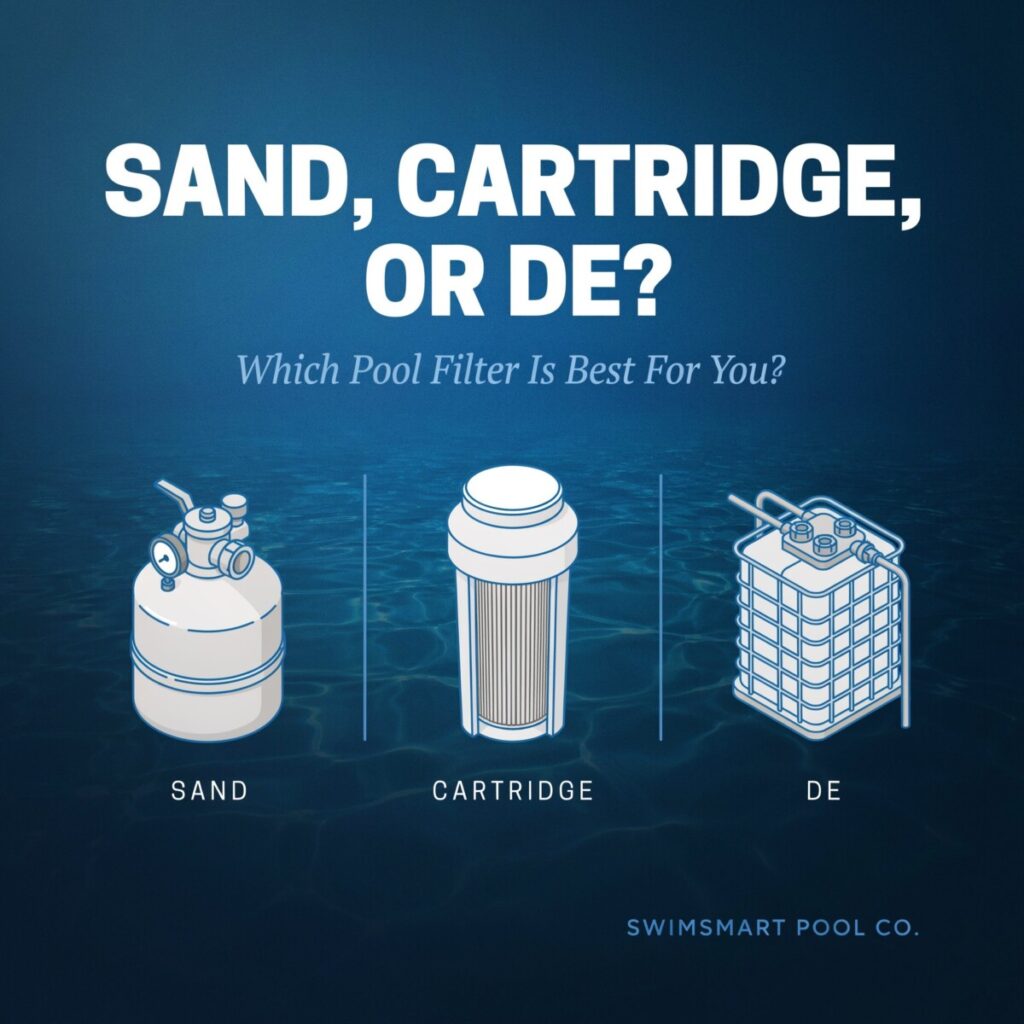
Your pool filter is the beating heart of your entire pool system. Without it, your backyard oasis would quickly devolve into a murky, algae-ridden swamp unfit for swimming. Yet when it’s time to install or replace a filter, most homeowners find themselves staring at three very different options — sand, cartridge, and diatomaceous earth (DE) — with no clear idea of which one is right for their needs.
Choosing the wrong filter can mean higher water bills, more weekends spent on maintenance, lackluster water clarity, or unnecessary expenses year after year. Whether you’re dealing with a sparkling in-ground pool in sunny Florida or battling hard-water mineral buildup in Arizona, the filter you select directly impacts your water quality, your wallet, and your sanity.
In this comprehensive pool filter comparison, we’ll break down exactly how sand, cartridge, and DE filters perform across every category that matters to US pool owners: filtration power, maintenance effort, cost, water usage, durability, and suitability for different pool sizes and climates. By the end, you’ll know precisely which pool filter is best for your home — and why.
How Pool Filters Work: A Quick Background
Before diving into the differences, let’s establish what every pool filter does at its core. A pool filter is responsible for physically trapping dirt, debris, algae, pollen, and microscopic particles as your pump circulates water through the system. The cleaner your filter media, the cleaner your pool.
The key metric for measuring a filter’s performance is its micron rating. A micron (short for micrometer) is one-millionth of a meter — roughly 1/25,000th of an inch. For context, a human hair is about 50–70 microns wide. The smaller the micron rating your filter can capture, the finer the particles it removes, and the crystal-clear your water will appear.
All three major filter types — sand, cartridge, and DE — work effectively when properly maintained. The real differences lie in how they trap debris, how fine their filtration is, and how much effort and money they demand from you over time. Understanding those distinctions is the foundation of a smart pool filter buyer guide.
Sand Filters: The Reliable Workhorse
What They Are
Sand pool filters are the most widely recognized type in the US. Inside a large, spherical tank sits a bed of specially graded #20 silica sand. As the pool pump pushes water downward through the sand bed, particles become trapped in the tiny spaces between sand grains. The filtered water then exits through laterals at the bottom and returns to your pool.
Filtration Ability
A standard silica sand filter captures particles in the 20–100 micron range. This makes sand filters the coarsest of the three types — perfectly capable of keeping your pool clean under normal conditions, but unable to polish water to the glass-like clarity that DE or cartridge filters can achieve. If microscopic finesse matters to you, sand won’t be your first choice.
The Pros of Sand Filters
Sand filters have earned their popularity for good reason. Here’s what makes them stand out:
- Easiest pool filter maintenance. When the pressure gauge rises roughly 25% above the clean, startup pressure, you simply flip a valve and backwash the sand filter — reversing water flow to flush trapped debris out through a waste line. The entire process takes about five minutes and requires no disassembly.
- Durability and low annual cost. The sand media itself lasts 5–7 years before needing replacement, and a bag of pool filter sand costs only $10–$25. There are no expensive cartridges to replace regularly.
- Lowest upfront purchase price. Sand filters are the most cost-effective pool filter option at the point of sale, making them the go-to choice for budget-conscious buyers and first-time pool owners.
- Handles heavy debris loads. If your pool goes green with algae or gets hammered by a dust storm, a sand filter won’t clog as quickly as cartridge or DE. You simply backwash and keep going — a huge advantage during spring openings or after major weather events.
The Cons of Sand Filters
- Highest water usage. Every backwash cycle sends hundreds of gallons of pool water down the drain. For homeowners in drought-prone states like California, Arizona, or parts of Texas, this water waste can be a serious concern — and may even violate local water-use restrictions.
- Less water clarity. Because sand only filters down to 20–100 microns, you won’t get the “diamond-clear” sparkle that finer filters deliver. Very fine dust, silt, and some algae spores can pass right through.
- Annual deep cleaning required. Over time, oils, minerals, and fine debris channel through the sand bed, reducing effectiveness. You’ll need to open the filter and chemically clean or degrease the sand at least once a year.
- Sand channeling. As sand ages, it can develop channels that allow unfiltered water to bypass the media entirely, degrading performance without obvious warning signs.
Best For
A sand pool filter is best for pool owners who prioritize ease, durability, and low cost over maximum water clarity. It’s the classic “set it and forget it” option — and the #1 best pool filter for home use among owners who don’t want to tinker with their equipment.
Cartridge Filters: Efficiency Meets Performance
What They Are
A cartridge pool filter uses one or more cylindrical, pleated fabric elements — typically made from spunbonded polyester or a paper-like composite — housed inside a sealed tank. Water is forced from the outside of the cartridge inward, and debris is trapped on the outer surface of the pleats. When it’s time to clean, you simply open the filter, pull the cartridge out, and hose it off.
Filtration Ability
Cartridge filters operate in the 10–20 micron range — meaning they capture particles roughly half the size that sand can handle. This translates to noticeably clearer water, especially in pools that see regular use or are surrounded by fine-particle environments like desert landscapes.
The Pros of Cartridge Filters
- Water-saving pool filter — no backwashing required. This is the single biggest advantage for eco-conscious pool owners and those in water-restricted areas. A no backwash pool filter means you save thousands of gallons per year — a critical factor for a pool filter for Florida homes where water tables fluctuate, or a pool filter for California drought conditions where every drop counts.
- Better clarity than sand, lower maintenance than DE. Cartridge filters hit the “Goldilocks zone”: significantly cleaner water than sand, without the complexity and ongoing cost of DE powder management.
- Reasonably priced upfront. While not as cheap as sand, cartridge filters are still fairly affordable to purchase, and many models come standard with new pool builds.
- Permanent media with long life. A quality long-life cartridge filter element can last 3–5 years (or more) with proper care, and only needs a chemical soak twice per season to dissolve embedded oils and minerals.
- Compact footprint. Cartridge filter tanks are generally smaller and more space-efficient than comparable sand or DE units — ideal for tight equipment pads.
The Cons of Cartridge Filters
- Manual tear-down for every cleaning. Unlike sand (where you just flip a valve), cleaning a cartridge requires you to open the filter housing, remove the element, hose it down thoroughly, and reassemble. When your pressure gauge spikes, this is hands-on work.
- Cartridge replacement costs. Even with great care, cartridges degrade. Replacement elements run $50–$150+ each, and larger filters may use multiple cartridges. Over 5–10 years, this adds up.
- Performance drops as it gets dirty. A cartridge filter’s effective micron rating increases as the pleats load with debris — some sources note it can degrade to filtering only down to ~40 microns when dirty, approaching sand-level performance until cleaned.
- Not ideal for heavy algae events. If your pool goes green, a cartridge filter can clog rapidly, requiring multiple cleanings in a single day. Sand is far more forgiving in these scenarios.
Best For
A cartridge pool filter is ideal for owners in water-conservation zones who want better clarity than sand without the complexity of DE. It’s the balanced, middle-path choice — and arguably the best pool filter for Arizona heat regions where water restrictions are common and pools run year-round.
DE (Diatomaceous Earth) Pool Filters: Maximum Clarity for Perfectionists
What They Are
A DE pool filter uses diatomaceous earth — a fine, chalky powder made from the fossilized microscopic skeletons of diatoms (single-celled aquatic organisms). Inside the filter tank, a grid or finger-style manifold is coated with a thin layer of DE powder. As water passes through this ultra-fine coating, debris is captured at a microscopic level. When the filter needs cleaning, the DE (along with trapped debris) is flushed out during backwashing, and fresh DE powder is added (“recharged”) through the skimmer.
Filtration Ability
This is where DE filters dominate. With a pool filter micron rating of just 2–5 microns, DE filters capture particles that are virtually invisible to the naked eye — including fine silt, algae spores, bacteria-sized particles, and even some large viruses. DE provides up to 50 times more filtration than sand and 7.5 times more than cartridge. The result is genuinely “polished” water that shimmers with an unmistakable clarity.
The Pros of DE Filters
- Best pool filter clarity, period. If you’ve ever seen a pool with water so clear it doesn’t look like there’s water in it — that pool likely has a DE filter. The pool filter polishing water effect is unmatched by any other residential filter type.
- Incredible filtration efficiency. Filtering down to 2–5 microns means DE catches contaminants that sand and cartridge let pass through. For pools surrounded by fine dust, pollen, or pollution, this matters enormously.
- No disassembly for routine cleaning. You don’t need to open the filter tank to clean a DE filter. You simply backwash and recharge the DE filter with fresh powder — a process similar in effort to backwashing a sand filter, plus a quick scoop of DE.
- Long-lasting media. The internal grids or fingers in a DE filter can last 10+ years before replacement. The DE powder itself is inexpensive (roughly $15–$30 per bag), making ongoing media costs manageable.
- Excellent for commercial and large pools. The combination of high flow rates, superior clarity, and relatively straightforward operation makes DE the preferred choice for many pool filter for large pool and commercial installations.
The Cons of DE Filters
- Backwashing + recharging required. Every backwash cycle wastes water and requires you to add fresh DE powder. This means higher water usage than cartridge, plus the recurring cost and effort of keeping DE powder on hand.
- More complex maintenance. DE filters demand more attention than sand or cartridge. You must manage DE inventory, ensure proper recharge amounts, perform periodic tear-down cleaning, and monitor for DE breakthrough (when powder blows back into the pool).
- Possible DE separation tank requirements. In some US municipalities — particularly in areas with strict environmental discharge rules — you may be required to install a DE separation tank to capture backwash water and prevent DE from entering storm drains or sewer systems. This adds to both upfront cost and equipment pad space.
- Clogs quickly during algae events. Because DE filters so finely, a green pool can overwhelm the filter in hours. You may need to backwash and recharge multiple times in a single day during algae kills, making DE the least forgiving option for problem pools.
- Highest upfront and operational cost. DE filters are the most expensive of the three to purchase and install. Combined with the ongoing cost of DE powder and potential separation tank requirements, they represent a premium investment.
- Health considerations. Inhaling dry DE powder can irritate lungs. While pool-grade DE is relatively safe when handled properly, you should always wear a mask and gloves when adding powder.
Best For
A diatomaceous earth filter is best for homeowners who demand perfection in water clarity and are willing to invest the time, money, and effort to maintain it. It’s the gold standard for best pool filter clarity — and the preferred choice for showpiece pools, competition pools, and homeowners who treat their pool as a luxury feature.
Side-by-Side Pool Filter Comparison
Here’s how the three types stack up across every category that matters:
| Feature | Sand Filter | Cartridge Filter | DE Filter |
|---|---|---|---|
| Filtration (microns) | 20–100 | 10–20 | 2–5 |
| Water Clarity | Good | Very Good | Excellent |
| Water Usage | High (backwash) | Low (no backwash) | Medium (backwash + DE) |
| Maintenance Difficulty | Easy | Moderate | High |
| Cleaning Method | Backwash valve | Remove + hose off | Backwash + recharge DE |
| Upfront Cost | Lowest ($200–$500) | Moderate ($300–$700) | Highest ($500–$1,200+) |
| Annual Operating Cost | Low | Moderate | Moderate–High |
| Media Lifespan | 5–7 years (sand) | 3–5 years (cartridge) | 10+ years (grids) |
| Handles Algae Well? | Yes | Poor | Poor |
| Best For | Ease & durability | Water conservation | Maximum clarity |
Key Takeaways from the Comparison
- For pure simplicity and affordability, sand wins hands down — but you sacrifice some water clarity and waste significant water during backwashing.
- For water conservation and solid clarity, cartridge hits the sweet spot, especially in drought-prone US states.
- For absolute, uncompromising water clarity, DE is in a class of its own — but it demands the most from you in maintenance complexity and cost.
Key Decision Factors: Which Pool Filter Should You Choose?
Choosing the best pool filter for home use comes down to honestly assessing your priorities. Walk through these six questions:
1. How Important Is Water Clarity to You?
If you want water so clear you can count the pebbles on the pool floor — the kind of “wow factor” that impresses every guest — DE is your answer. If you’re satisfied with clean, clear water that looks great without needing to be absolutely flawless, cartridge gets you very close. If “clear enough to swim in” is your standard, sand will serve you well.
2. Do You Live in a Water-Conservation Zone?
Homeowners in California, Arizona, Nevada, parts of Texas, and other drought-prone regions should seriously consider cartridge filters. A water-saving pool filter that never requires backwashing can save you thousands of gallons per year — and keep you on the right side of local water-use regulations. The best pool filter for California drought conditions is almost always cartridge.
3. How Much Maintenance Effort Can You Tolerate?
Be honest with yourself. If you want to minimize hands-on time with your pool equipment, sand is the clear winner — flip a valve, done in five minutes. Cartridge requires periodic disassembly and hosing, which takes 20–30 minutes. DE combines backwashing with DE recharging, periodic tear-downs, and DE inventory management. Match your filter to your lifestyle.
4. What’s Your Pool Size?
For a pool filter for small pool applications (under 20,000 gallons), any of the three types work well — but cartridge often offers the best value-to-performance ratio. For a pool filter for large pool installations (30,000+ gallons) or commercial settings, DE is frequently the preferred option for its high flow rates and superior clarity. Sand remains popular for very large pools where ease of maintenance outweighs clarity concerns.
5. What’s Your Budget?
- Tight upfront budget? → Sand is the most cost-effective pool filter to purchase and install.
- Balanced long-term value? → Cartridge offers great clarity with moderate cost.
- Premium experience? → DE delivers unmatched results at a premium price.
6. Do You Frequently Battle Algae or Cloudiness?
If your pool has a history of algae blooms, heavy pollen loads, or frequent dust storms, sand is the most resilient option. It tolerates heavy loading and recovers quickly with a simple backwash. Cartridge and DE filters will clog rapidly under the same conditions, requiring frustrating mid-crisis cleanings.
Maintenance Tips for Each Filter Type
No matter which filter you choose, proper pool filter maintenance is the key to long-term performance and equipment longevity.
Sand Filter Maintenance
- Backwash when the pressure gauge reads 8–10 PSI above the clean, startup pressure (typically a 25% increase).
- Perform a full deep clean of the sand bed annually using a filter cleaner/degreaser to dissolve oils, minerals, and embedded fines.
- Replace the sand every 5–7 years. Over time, sand grains become smooth and rounded, losing their ability to trap particles.
- Keep your pool water chemistry balanced — high calcium hardness can cause scale buildup inside the filter tank, reducing efficiency.
Cartridge Filter Maintenance
- Clean the cartridge by removing it and hosing it off (top to bottom, at an angle) when pressure rises 8–10 PSI above clean pressure.
- Perform a chemical soak (TSP or a dedicated cartridge cleaner) twice per season to dissolve embedded oils and minerals that hosing alone can’t remove.
- Inspect pleats regularly for tears, fraying, or band separation. A damaged cartridge cannot filter effectively.
- Replace cartridges every 3–5 years, or sooner if they show signs of permanent clogging or damage.
- Maintain balanced water chemistry to prevent calcium scaling on the fabric media.
DE Filter Maintenance
- Backwash when pressure rises 8–10 PSI above clean pressure, then recharge with fresh DE powder (calculate the correct amount based on your filter’s square footage — typically 1–2 lbs per 10 sq. ft.).
- Perform an annual tear-down to manually clean the grids or fingers and inspect for torn fabric or broken manifolds.
- Consider a DE separation tank if required by local codes — this captures backwash water so DE can settle out before disposal.
- Store DE powder in a dry, sealed container away from moisture. Always wear a dust mask and gloves when handling.
- Keep water chemistry balanced — high pH and calcium can cause DE to “clump” on grids, reducing filtration and increasing pressure.
Universal Tip: Water Chemistry Matters
Regardless of filter type, balanced pool water chemistry is the single biggest factor in filter lifespan and performance. Unbalanced pH, high calcium hardness, and excessive stabilizer (CYA) levels can all cause scale, clogging, and premature media degradation inside your filter. Test your water weekly and adjust accordingly — your filter will thank you.
Conclusion: Your Pool, Your Priorities
There’s no single “best” pool filter for everyone — and anyone who tells you otherwise is oversimplifying the decision. The right pool filter recommendation depends on where you live, how you use your pool, what you value most, and how much time and money you’re willing to invest.
Here’s the bottom line:
- 🔧 Sand filters are the tried-and-true workhorse: affordable, durable, and low-maintenance — ideal if ease and simplicity are your top priorities.
- 💧 Cartridge filters are the balanced, eco-friendly choice: better clarity than sand with zero backwashing — perfect for water-conscious homeowners in drought-prone US states.
- ✨ DE filters are the perfectionist’s tool: unmatched water clarity at the cost of higher complexity and investment — the gold standard for crystal-clear, polished water.
Take time to honestly evaluate your needs using the decision factors above. Consider your climate, your pool size, your maintenance tolerance, and your budget. There’s no wrong answer — only the answer that’s wrong for you.
Ready to upgrade? Compare local prices, read verified customer reviews, and find the perfect in-ground pool filter for your home. Whether you’re searching for the best pool filter USA-wide or a budget-friendly option for a weekend DIY installation, the information in this guide will help you make a confident, informed choice. Clear water is ahead — you just have to pick the filter that gets you there. 🏊♂️