Your no-nonsense blueprint to crystal-clear water, lower maintenance, and smarter spending — updated for 2026.
Why Your Pool Filter Matters More Than You Think
If you’ve ever stepped outside on a hot July morning, coffee in hand, only to find your pool looking more like a swamp than a swimming hole, you already know the pain of a struggling filtration system. Clean water doesn’t happen by accident — it happens because your pool filter is quietly doing the heavy lifting every single day.
Your pool filter is the unsung hero of your backyard oasis. It traps debris, catches microscopic contaminants, and keeps your water safe for your family. Choose the wrong one, and you’re staring down cloudy pool water, skyrocketing chemical costs, and weekend after weekend spent scrubbing instead of swimming.
In this guide, we’re going to walk through every filter type, bust common myths, and help you pick the perfect pool filter based on your pool size, budget, and how much elbow grease you’re willing to put in. Let’s dive in.
The Three Main Types of Pool Filters
Every residential pool in the United States runs on one of three filtration technologies. Each has trade-offs in clarity, cost, and maintenance — and understanding those trade-offs is the single most important decision you’ll make as a pool owner.
1. Sand Pool Filters
Sand filters are the workhorses of the American backyard. They’ve been around for decades, and for good reason — they’re simple, durable, and forgiving.
How it works: Water flows through a tank filled with specially graded #20 silica sand. The sand traps particles down to about 20–40 microns, and clean water returns to the pool.
Maintenance: When pressure rises 8–10 PSI above normal, you simply flip a multiport valve to “backwash” — reversing water flow to flush trapped dirt out through a waste line. The whole process takes about 3 minutes.
Lifespan: The sand itself lasts 5–7 years before it needs replacing. The tank can last 10–15 years.
💡 Unique Insight: Many homeowners don’t realize that new sand actually filters worse than slightly aged sand. Fresh silica has sharp edges that break down over the first few weeks, eventually creating the ideal micro-texture for trapping debris.
Pros and Cons
| ✅ Pros | ❌ Cons |
|---|---|
| Lowest upfront cost ($250–$600) | Lowest filtration clarity (20–40 microns) |
| Easiest maintenance (just backwash) | Wastes 200–500 gallons per backwash |
| Extremely durable | Sand channels can form over time |
| Works with most pool pumps | Not ideal for hard-water areas |
2. Cartridge Pool Filters
Cartridge filters have exploded in popularity over the last decade — especially in drought-prone states like California, Arizona, and Texas, where backwashing wastes precious water.
How it works: Water passes through a pleated fabric cartridge (usually polyester or cellulose blend) that traps particles as small as 10–15 microns. That’s roughly half the size of what sand catches.
Maintenance: Instead of backwashing, you remove the cartridge, hose it off, and occasionally soak it in a filter cleaner solution 1–2 times per year. Full replacement happens every 3–5 years.
Lifespan: Cartridges are the consumable component — budget $60–$150 per replacement.
Pros and Cons
| ✅ Pros | ❌ Cons |
|---|---|
| Better water clarity than sand | Higher long-term costs (cartridge replacements) |
| Zero water waste | More hands-on cleaning (2–4x per year) |
| Works at lower pump pressures | Clogs faster in heavy-debris environments |
| Eco-friendly in drought areas | Cartridges degrade with improper storage |
3. Diatomaceous Earth (DE) Pool Filters
DE filters are the gold standard for water clarity. If you’ve ever marveled at the mirror-like water in a resort pool, chances are it was running through DE.
How it works: Inside the tank, a grid is coated with a fine powder made from fossilized diatoms (microscopic algae). This powder traps particles down to an incredible 2–5 microns — small enough to catch some bacteria and algae spores that sand and cartridge miss entirely.
Maintenance: Like sand filters, DE filters backwash, but they require you to add fresh DE powder ($15–$30 per recharge) through the skimmer after each cycle.
Lifespan: The internal grids last 7–10 years with proper care.
Pros and Cons
| ✅ Pros | ❌ Cons |
|---|---|
| Best water clarity (2–5 microns) | Highest upfront cost ($500–$1,200+) |
| Long intervals between backwashes | DE powder is a respiratory irritant when dry |
| Great for large or commercial pools | More complex maintenance |
| Lower long-term chemical usage | Backwashing wastes water + DE powder |
How Each Pool Filter Works: The Technical Rundown
📊 Expand: Micron Rating Comparison
To give you a sense of scale:
- Human hair: ~70 microns
- Pollen: ~30 microns
- E. coli bacteria: ~2 microns
- Fine silt: ~5–10 microns
| Filter Type | Micron Rating | What It Catches |
|---|---|---|
| Sand | 20–40 μm | Leaves, bugs, larger debris |
| Cartridge | 10–15 μm | Fine dust, some algae |
| DE | 2–5 μm | Some bacteria, fine silt, algae spores |
The core physics is straightforward: smaller micron ratings = clearer water = fewer chemicals needed. But clarity isn’t the only metric that matters. Flow rate, pressure drop, and energy consumption all play a role in total cost of ownership.
A properly sized pool filtration system should turn over your entire pool volume at least once every 8 hours. For a typical 20,000-gallon in-ground pool, that means a flow rate around 42 GPM (gallons per minute) — and your filter must handle that flow without choking.
Pool Filter Comparison Chart
Visual Concept #1: Side-by-side infographic showing sand, cartridge, and DE filters with icons for cost, clarity, maintenance effort, and lifespan.
Alt text: “Pool filter comparison chart showing sand, cartridge, and DE filter types with pros and cons for US homeowners.”
Here’s our at-a-glance breakdown:
| Feature | Sand Filter | Cartridge Filter | DE Filter |
|---|---|---|---|
| Upfront Cost | $250–$600 | $300–$800 | $500–$1,200 |
| Micron Rating | 20–40 μm | 10–15 μm | 2–5 μm |
| Maintenance Frequency | Monthly backwash | 4–6x/year cleaning | 2–3x/year backwash |
| Water Waste | High (backwash) | None | High (backwash + DE) |
| Water Clarity | Good | Very Good | Excellent |
| Lifespan | 10–15 years | 3–5 (cartridges) | 7–10 (grids) |
| Best For | Budget-conscious owners | Eco-conscious / drought areas | Luxury / pristine pools |
Maintenance Requirements by Filter Type
This is where most pool owners get tripped up. A filter is only as good as its maintenance schedule.
Sand Filter Maintenance
- Weekly: Check pool filter pressure gauge
- Monthly (or when pressure rises 8–10 PSI): Backwash for 2–3 minutes
- Annually: Deep clean with sand filter cleaner
- Every 5–7 years: Replace sand
Cartridge Filter Maintenance
- Monthly: Remove and hose off cartridge
- Every 3–4 months: Soak in cartridge cleaning solution overnight
- Every 3–5 years: Replace pool filter cartridge
DE Filter Maintenance
- Every 1–3 months: Backwash and recharge with fresh DE powder (usually ~1 lb per sq ft of filter area)
- Annually: Open tank and inspect grids for tears
- Every 7–10 years: Replace internal grids
🔑 Pro Tip: Regardless of filter type, a pool filter pressure gauge that reads high is your #1 signal that cleaning is overdue. Ignoring high pool filter pressure can burn out your pump motor — a $500+ repair you don’t need.
Pool Filter Cost Comparison
Let’s talk dollars and sense. When comparing pool filter cost, you have to look at the total cost of ownership over 10 years, not just the sticker price.
10-Year Cost of Ownership (20,000-gallon pool):

Sand Filter:
  Initial:         $450
  Sand (2x):       $80
  Water waste:     $150
  Energy:          $200
  TOTAL:          ~$880

Cartridge Filter:
  Initial:         $550
  Cartridges (3x): $350
  Cleaning sol:    $120
  Energy:          $180
  TOTAL:          ~$1,200

DE Filter:
  Initial:         $800
  DE powder:       $250
  Water waste:     $150
  Energy:          $200
  TOTAL:          ~$1,400
Sand wins on pure cost. DE wins on water clarity. Cartridge splits the difference — ideal if water conservation matters to you.
How to Choose the Right Pool Filter Size
Choosing the correct pool filter size is arguably more important than choosing the type. An undersized filter runs constantly, wears out fast, and leaves your water murky. Oversized filters waste money upfront and may short-cycle.
The Sizing Formula
Here’s how I calculate it:
- Find your pool volume (gallons)
- Divide by 8 hours (target turnover)
- Divide by 60 (convert to GPM)
- Multiply by 1.25 (add 25% safety margin)
Example: For a pool filter for 15000 gallon pool:
$$\frac{15{,}000 \text{ gal}}{8 \text{ hr}} \div 60 \times 1.25 = 39 \text{ GPM required}$$
You’d want a filter rated for at least 40–50 GPM — typically a 200–250 sq ft cartridge filter or a 24-inch sand filter.
📐 Expand: Quick Size Chart by Pool Volume
| Pool Volume | Sand Filter | Cartridge | DE Filter |
|---|---|---|---|
| Up to 10,000 gal | 18″ tank | 150 sq ft | 24 sq ft |
| 10,000–20,000 gal | 24″ tank | 250 sq ft | 36 sq ft |
| 20,000–30,000 gal | 30″ tank | 400 sq ft | 48 sq ft |
| 30,000–40,000 gal | 36″ tank | 500+ sq ft | 60+ sq ft |
Best Pool Filter for Above Ground Pools
If you’ve got an above-ground pool, you’re likely working with a smaller volume (5,000–20,000 gallons), lower pump horsepower, and a tighter budget. Here’s my honest take:
My pick: Cartridge filters are the best pool filter for above ground pool setups in 2026. Here’s why:
- Most above-ground pools sit on patios or decks where backwash water has nowhere to drain
- Lower flow rates match cartridge filters perfectly
- Upfront cost is reasonable ($200–$400)
- No sand to haul or DE powder to handle
Runner-up: Sand filters for larger above-ground pools (18,000+ gallons) where filtration capacity matters more than backwash logistics.
For a 15,000-gallon above-ground pool, a 200 sq ft cartridge filter like the Pentair Clean & Clear series has dominated pool filter reviews for years — it’s affordable, reliable, and the cartridges are easy to find at any big-box store.
Best Pool Filter for In Ground Pools
In-ground pools are a different beast. Higher volume, more debris (especially from surrounding trees), and the infrastructure to handle backwash drainage. Here’s my breakdown:
Best all-around: Cartridge filters for homeowners who want great clarity without the DE hassle.
Best for luxury/large pools: DE filters. If you have a 30,000+ gallon pool with a saltwater generator or you’re chasing that resort-level clarity, DE is worth the investment.
Best for budget and simplicity: Sand filters still shine for basic in-ground pools where “good enough” clarity is fine and you want minimal maintenance.
Real-world scenario: A family in Florida with a 25,000-gallon screened-in pool and heavy pollen load would do best with a cartridge filter (pollen is 30 microns, well within cartridge range) paired with a variable-speed pump. A sand filter would struggle with the pollen buildup, forcing weekly backwashes.
Sand Filter vs Cartridge Filter: The Head-to-Head
This is the debate I hear most often. Let’s settle it quickly:
Choose sand if:
- You want the cheapest upfront option
- Your pool is in a region without water restrictions
- You prefer the “set it and forget it” approach
Choose cartridge if:
- You live in a drought-prone state (CA, AZ, TX, NV)
- You value better water clarity
- You don’t mind cleaning 4x per year
The sand filter vs cartridge filter debate ultimately comes down to one question: Is your time or your water more valuable? If water is scarce, cartridge wins. If time is scarce, sand wins.
Common Pool Filter Problems and Fixes
🔧 Expand: Troubleshooting Guide for the Top 5 Filter Issues
1. Cloudy Pool Water
Cause: Filter not catching fine particles.
Fix: Check micron rating — you may need to upgrade. For sand filters, try adding a filter aid like ZeoSand or clarifier.
2. High Pool Filter Pressure
Cause: Clogged pool filter or blocked return lines.
Fix: Backwash (sand/DE) or clean cartridge immediately. If pressure stays high, check for blocked skimmer baskets and pump strainers.
3. Low Pool Filter Pressure
Cause: Clogged pump strainer, air leak in suction line, or broken impeller.
Fix: Clean strainer basket first. If that doesn’t work, check for air bubbles in pump basket lid.
4. Dirty Pool Water Fix That Won’t Stick
Cause: Undersized filter or failing pump.
Fix: Verify your turnover rate meets the 8-hour rule. Consider upgrading to a larger filter.
5. DE Powder Returning to Pool
Cause: Torn grid or cracked manifold inside DE filter.
Fix: Open the tank, inspect grids, and replace any damaged components.
Quick Takeaways
- Three main types exist: sand (cheapest), cartridge (balanced), DE (clearest water)
- Pool filter size matters more than type — size correctly using the turnover formula
- Cartridge filters are best for above ground pools and drought-prone regions
- DE filters deliver resort-level clarity but require more complex maintenance
- Expect to spend $880–$1,400 over 10 years depending on filter type
- Check your pressure gauge weekly — it’s your filter’s check-engine light
- Top-rated pool filters 2026: Pentair, Hayward, and Jandy dominate residential reviews
Conclusion
Your pool filter is the beating heart of your pool’s ecosystem. Get it right, and you’ll enjoy years of sparkling water with minimal hassle. Get it wrong, and you’ll spend every weekend fighting cloudy water, burning through chemicals, and cursing the day you installed a pool.
Sand filters win on simplicity and cost. Cartridge filters balance clarity, eco-friendliness, and moderate maintenance. DE filters deliver unparalleled water quality for those willing to invest in the upkeep.
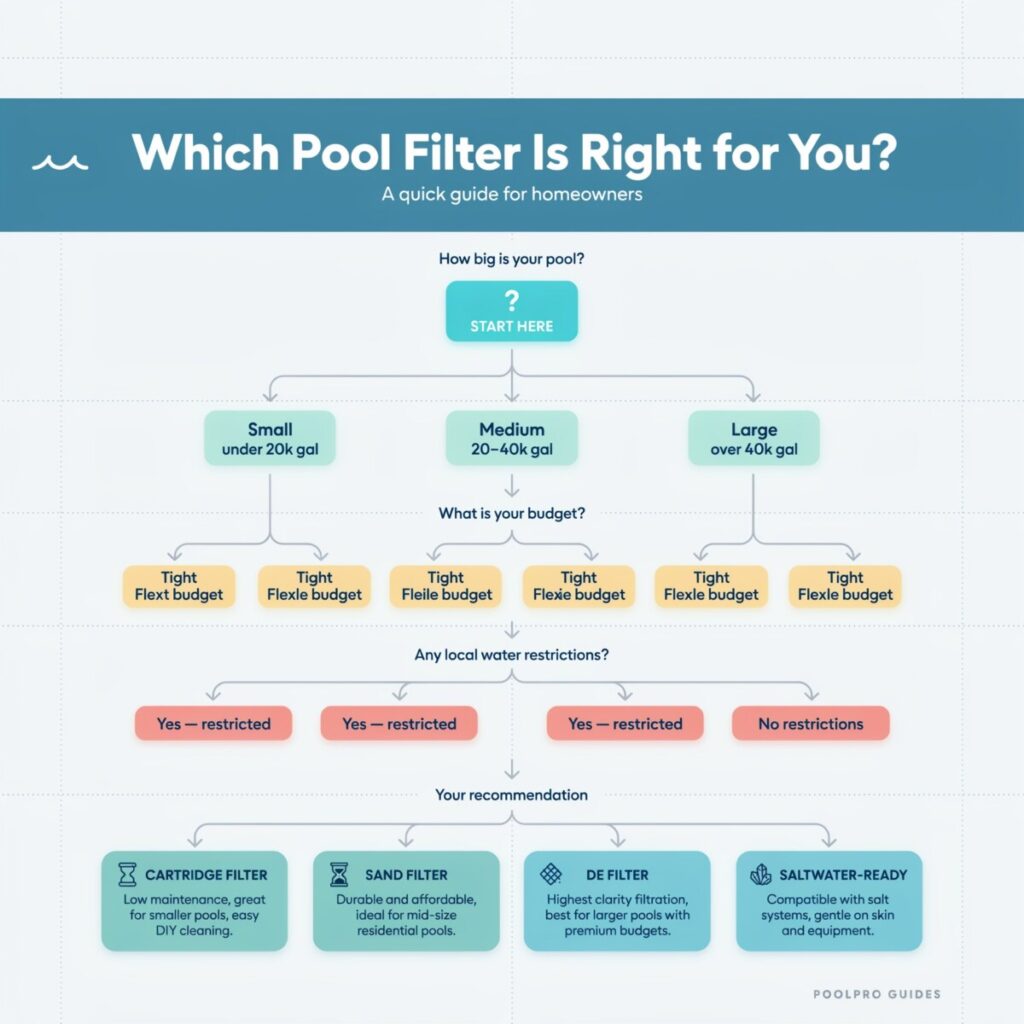
Before you buy, ask yourself three questions: How big is my pool? How much time do I have for maintenance? And do I live in a water-restricted area? Answer those, and the right filter practically picks itself.
Ready to upgrade? Shop our curated list of top-rated pool filters and grab our free downloadable pool filter comparison chart to take with you to the store.
Frequently Asked Questions
1. How often should I clean my pool filter?
It depends on the type. Sand filters should be backwashed monthly or when pressure rises 8–10 PSI. Cartridge filters need cleaning every 1–3 months during swim season. DE filters typically require backwashing every 1–3 months followed by a DE powder recharge. Always follow the pool filter cleaning schedule recommended by your manufacturer.
2. Can I replace a sand filter with a cartridge filter?
Absolutely. Many homeowners upgrade from sand to cartridge when they move to drought-prone areas or want better water clarity. You’ll need to match the flow rate (GPM) of your existing pool pump and filter combo and may need minor plumbing adjustments.
3. How do I know if my pool filter is too small?
If you’re running your pump 12+ hours per day and still seeing cloudy pool water, your filter is likely undersized. Also check: if your pool filter pressure gauge maxes out quickly after cleaning, or if algae blooms are frequent despite proper chemistry, it’s time to size up.
4. What’s the most affordable pool filter that still works well?
For most US homeowners, a sand filter from Hayward or Pentair in the $300–$450 range offers the best affordable pool filter value. They’re cheap to run, last 10+ years, and work well for pools up to 25,000 gallons.
5. Do I need a pool filter if I have a saltwater pool?
Yes — 100%. A saltwater chlorine generator sanitizes your water, but it doesn’t filter debris or particles. You still need a physical pool filtration system to remove dirt, bugs, and microscopic contaminants. The salt system and filter work together, not as substitutes.
Share Your Pool Story!
Have you switched filter types and noticed a big difference? Got a question about sizing or maintenance that we didn’t cover? Drop a comment below — we read every one, and we’d love to hear from you. If this guide helped you pick the right pool filter, share it with a fellow pool owner who’s struggling with cloudy water. Together, we can make every backyard pool crystal clear. 💦
References
- Pool & Hot Tub Alliance (PHTA) — APSP Standards for Residential Pool Filtration
phtapools.org - U.S. Environmental Protection Agency (EPA) — Water Conservation in Residential Pool Maintenance
epa.gov/watersense - Pool & Spa News — 2026 Filtration Technology Trends Report
poolspanews.com - Pentair Aquatic Systems — Residential Pool Filter Sizing & Selection Guide
pentair.com - Hayward Industries — Pool Filtration Technical Reference Manual
hayward-poolproducts.com