
If you own a pool in the US, you already know the battle: one day the water sparkles, and the next it’s a floating salad of oak leaves, pollen dust, or fine desert sand. Whether you’re in the leaf-heavy Northeast, the pollen-soaked Southeast, or the wind-blown Southwest, keeping debris out of your water is the single biggest factor in how much time and money you spend on pool maintenance each season.
The good news? Modern pool skimmers and automatic pool vacuum systems have come a long way. Today’s options range from simple $30 clip-on skimmer baskets to fully autonomous robotic pool cleaners that map your pool floor and scrub walls on a schedule. In this guide, we’ll walk you through how these systems work, compare the pros and cons of each type, and give you a practical buying checklist so you can choose the right pool cleaning equipment for your home — and finally spend more time swimming and less time scooping.
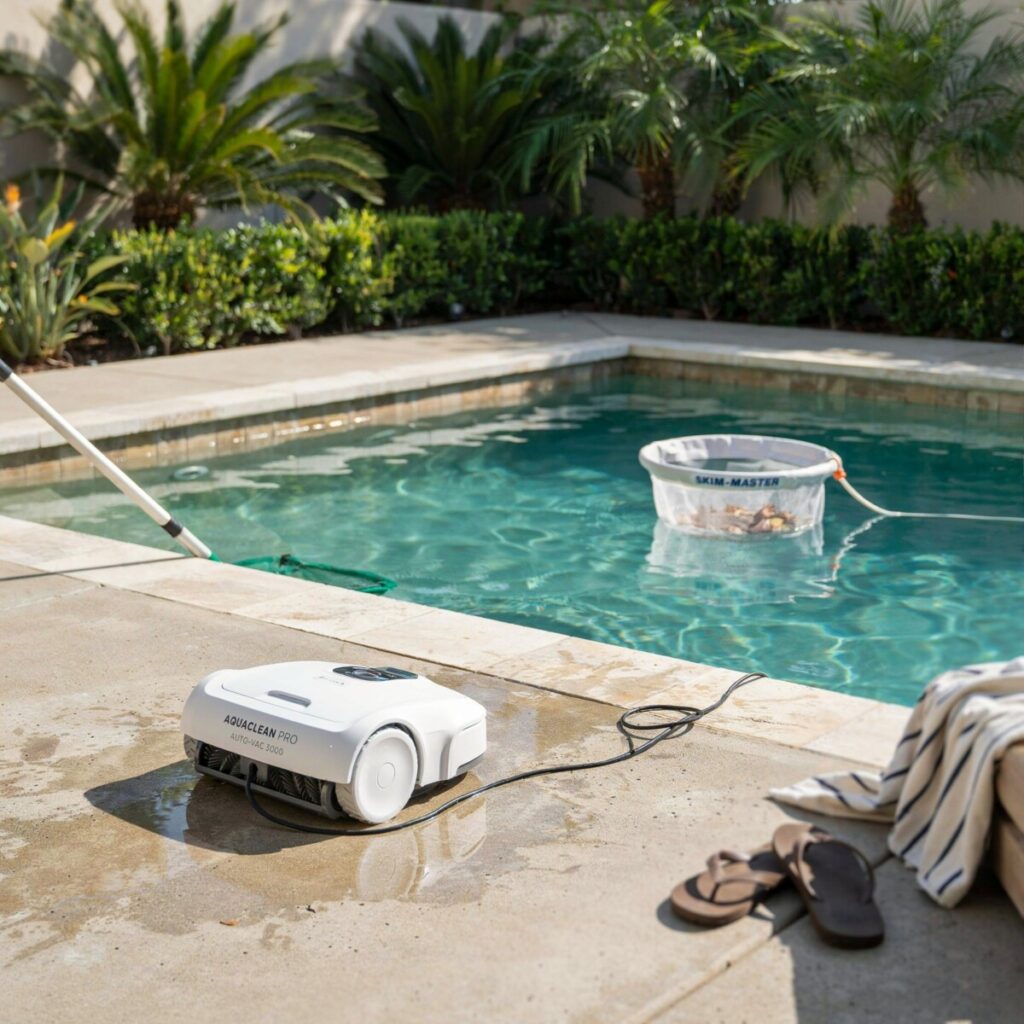
How Pool Skimmers Work
At its core, a pool skimmer is a debris collection gate that sits at the water’s surface. It uses the suction created by your pool filtration system — specifically your pool pump — to pull the top layer of water (where most floating debris lives) into a removable pool skimmer basket.
Built-In vs. Surface Skimmers
There are two main categories:
- Built-in (wall-mounted) skimmers — Permanently installed into the pool wall during construction, these are the standard on most in-ground pool skimmer setups. They connect directly to your pump’s suction line.
- Surface skimmers — These are standalone, floating, or clip-on units that sit on top of the water. They’re popular for above-ground pools and portable spas.
Types of Skimmer Mechanics
- Suction skimmers rely on your pool pump’s draw. They’re simple, reliable, and have no moving parts beyond the weir door (a small flap that lets water in but keeps debris from floating back out).
- Automatic surface skimmers are self-propelled or solar-powered units that roam the pool surface, collecting debris into an internal tray — independent of your pump.
- Floating skimmers are passive devices that drift with currents and wind, trapping leaves and insects in a net bag.
How Water Flows Through the System
Here’s the basic path your pool water takes during a skimming cycle:
Surface water (debris-laden)
        ↓
   Skimmer opening (weir door)
        ↓
   Skimmer basket (traps large debris)
        ↓
   Pool pump (creates suction)
        ↓
   Filter (sand, cartridge, or DE)
        ↓
   Return jets (clean water back into pool)
📐 Quick math: How fast does water flow through a skimmer?
A typical residential pool pump moves between 40–80 gallons per minute (GPM). Since most pools have 1–3 skimmers, each skimmer handles roughly:
Flow per skimmer=Number of skimmers/Total GPM
For a 60 GPM pump with 2 skimmers, that’s ~30 GPM per skimmer — enough to turnover surface water several times per day.
Types of Pool Skimmers and Best Uses
Not all skimmers are created equal. Here’s a breakdown of the most common types available in 2026 and when each one makes sense.
Built-In (Deck-Mounted) Skimmers
Best for: In-ground concrete, fiberglass, and vinyl-liner pools.
These are the gold standard. Installed flush with the pool wall, they offer reliable, continuous skimming as long as your pump is running. Replacement parts are widely available, and most pool builders include at least one as standard.
Above-Ground Pool Skimmers
Best for: Above-ground pools, soft-sided pools, and temporary setups.
Above-ground pool skimmer options include:
- Clip-on skimmers that attach to the pool rail with a bracket
- Universal wall-mount skimmers that require cutting a hole in the pool wall (semi-permanent)
- Hang-over skimmers that drape over the pool edge
Floating and Robotic Surface Skimmers
Best for: Pools with heavy surface debris, koi ponds, and supplemental skimming.
Solar-powered robotic surface skimmers (like the popular Otterbine and Betta models) patrol the surface autonomously, collecting debris into a tray you empty every few days. They’re ideal if your pool sits under large trees or in a high-pollen area.
Quick Buyer Checklist
Before you buy, ask yourself:
- [ ] What type of pool do I have? (in-ground vs. above-ground)
- [ ] What’s my primary debris? (leaves, pollen, insects, sand)
- [ ] Is my pool pump strong enough to support a suction skimmer?
- [ ] What’s my budget? ($30–$800+ range)
- [ ] Do I need portable/seasonal or permanent installation?
Introduction to Automatic Pool Vacuum Cleaners
While skimmers handle what floats, automatic pool vacuum systems handle what sinks — dirt, sand, algae, and fine debris on your pool floor and walls. There are three major types, and choosing the right one depends on your pool’s size, surface, and your budget.
Suction-Side Vacuums
A suction-side vacuum connects to your pool’s existing skimmer line or a dedicated suction port. Your pool pump provides all the power. These are the simplest and most affordable automatic vacuums.
- How they work: Suction pulls the vacuum across the pool floor in a semi-random pattern, sending debris through the pump and into your filter.
- Best for: Small-to-medium pools with fine debris (sand, silt).
- Drawback: Adds load to your pump and filter, can reduce skimming efficiency.
Pressure-Side Vacuums
A pressure-side vacuum uses the return (pressure) side of your plumbing — often with a dedicated booster pump for pool vacuum systems — to propel the cleaner and push debris into an attached bag.
- How they work: Water pressure drives the unit, and a debris bag catches leaves and larger particles before they reach your filter.
- Best for: Pools with heavy leaf litter, larger debris, and medium-to-large pools.
- Drawback: Requires a booster pump ($300–$900 installed), higher energy cost.
Robotic Pool Cleaners
A robotic pool cleaner is a fully self-contained unit with its own motor, brushes, and filter cartridge. It plugs into a standard GFCI outlet and operates independently of your pool pump.
- How they work: Smart navigation (some use mapping algorithms) drives the robot across the floor, up walls, and along the waterline, scrubbing and vacuuming simultaneously.
- Best for: Any pool type, heavy-use pools, and homeowners who want a “set it and forget it” solution.
- Drawback: Higher upfront cost ($300–$1,200+), but often the best best pool vacuum 2026 value long-term.
⏱ Typical cleaning cycle times by vacuum type
| Vacuum Type | Cycle Time | Coverage |
|---|---|---|
| Suction-side | 2–4 hours | Random pattern |
| Pressure-side | 1–3 hours | Semi-random |
| Robotic | 1.5–3 hours | Mapped/structured |
Comparing Skimmers vs. Automatic Vacuums
So, which do you need? For most US homeowners, the answer is both — they serve different purposes and work best as a team.
| Feature | Pool Skimmer | Automatic Pool Vacuum |
|---|---|---|
| Primary purpose | Removes floating surface debris | Removes sunken floor/wall debris |
| Debris size captured | Leaves, insects, pollen, twigs | Sand, dirt, algae, fine sediment |
| Frequency of use | Continuous (whenever pump runs) | 1–3× per week (scheduled) |
| Maintenance required | Empty basket weekly | Clean filter/bag, replace brushes |
| Cost range | $30–$800 | $100–$1,200+ |
| Pool pump dependency | Yes (for suction types) | Varies (robotics are independent) |
When a Skimmer Is Enough
If your pool is small, screened-in, or in a low-debris area (think: Arizona desert with minimal vegetation), a good skimmer and occasional manual brushing may be all you need.
When You Need an Automatic Vacuum
If your pool collects sand, dirt, or algae on the floor — or if you’re tired of weekly manual vacuuming sessions that eat up 45+ minutes — an automatic vacuum is a game-changer.
The Hybrid Approach (Recommended for Most Homes)
Pair a built-in skimmer with a robotic pool cleaner for the lowest-maintenance combo. Schedule the robot to run 2–3 times per week during off-peak hours, and let your skimmer handle surface debris around the clock.
Buying Guide: How to Choose the Right Skimmer and Vacuum
Choosing the right pool cleaning equipment comes down to matching specs to your specific pool and lifestyle. Here’s what to evaluate.
Key Factors to Consider
- Pool size and shape — Larger pools need higher-flow skimmers and vacuums with longer cycle capabilities.
- Pool surface — Vinyl liners need softer brushes; plaster and pebble surfaces can handle aggressive scrubbing.
- Primary debris type — Leaves demand pressure-side or robotic vacuums with large debris trays; fine sand favors suction-side or robotic units.
- Suction power — Check your pump’s GPM and HP (horsepower). A 1 HP pump at ~60 GPM handles most residential skimmers.
- Pool pump compatibility — Ensure the skimmer or suction-side vacuum matches your existing plumbing size (typically 1.5″ or 2″ pipe).
- Energy efficiency — Look for energy-efficient pool equipment with low-voltage motors and variable-speed compatibility.
- Warranty and brand reputation — Top brands (Hayward, Pentair, Polaris, Dolphin, Water Technix) typically offer 1–3 year warranties.
Top Features to Prioritize
- ✅ Programmable schedules (set and forget)
- ✅ Remote control or app connectivity (Wi-Fi enabled robots)
- ✅ Tangle-free swivel hoses and anti-tangle brush systems
- ✅ Fine filter cartridges (some robotics offer HEPA-like filtration down to 2–5 microns)
- ✅ Low-voltage safety (24V or less for robotics — critical for families with kids)
- ✅ Quick-release baskets for easy emptying
Example Selection Scenarios
| Scenario | Recommended Skimmer | Recommended Vacuum |
|---|---|---|
| Small Northeast backyard pool, heavy leaf fall | Built-in skimmer + floating solar skimmer | Pressure-side vacuum with leaf bag |
| Florida pool, pollen and bug-heavy | Built-in skimmer (oversized basket) | Robotic pool cleaner (fine filter) |
| Southwest desert pool, sand and dust | Built-in skimmer | Robotic pool cleaner (scrubbing brushes) |
| Above-ground pool, budget-conscious | Clip-on above-ground skimmer | Suction-side vacuum |
Installation, Setup, and Maintenance Tips
Getting your equipment up and running doesn’t have to be complicated. Here’s a practical walkthrough.
Installing a Built-In Skimmer
- Shut off your pool pump and relieve system pressure.
- Cut the opening in the pool wall at the correct height (waterline should sit roughly halfway up the skimmer throat).
- Plumb the suction line from the skimmer to the pump using PVC pipe and primer/cement.
- Install the skimmer faceplate and gasket — ensure a watertight seal.
- Drop in the basket, set the weir door, and restart the pump. Check for leaks.
Installing a Clip-On Above-Ground Skimmer
- Choose a location near a return jet (helps push debris toward the skimmer).
- Clip the mounting bracket to the pool rail.
- Connect the hose to your pump’s suction port or use the included adapter.
- Submerge the skimmer to fill it with water (prevents air lock), then restart the pump.
Setting Up a Robotic Vacuum
- Unroll the cable and lay it flat to remove kinks.
- Place the robot in the pool — don’t drop it from the edge (protects tracks and brushes).
- Plug into a GFCI-protected outlet.
- Press start or schedule via the app.
Common troubleshooting: Robot gets stuck on stairs → reposition the pool’s main drain cover or use a “stair escape” mode if available. Tangled hoses → use a hose float positioned 4–5 feet from the robot.
Routine Maintenance Checklist
📋 Monthly & seasonal maintenance tasks
Weekly:
- [ ] Empty skimmer basket(s)
- [ ] Check weir door operation
- [ ] Inspect vacuum hose for cracks
Monthly:
- [ ] Clean or replace robot filter cartridge
- [ ] Inspect vacuum brushes for wear (replace every 6–12 months)
- [ ] Check all O-rings and gaskets, lubricate with pool-safe silicone grease
- [ ] Backwashing filter if pressure gauge reads 8–10 PSI above clean baseline
Seasonal (fall/spring):
- [ ] Increase skimming frequency during leaf-drop season
- [ ] Winterize pool skimmer — drain suction lines, install a skimmer plug or “Gizmo” to prevent freeze cracking in cold climates
- [ ] Store portable vacuums indoors during winter; remove batteries from cordless units
Energy-Saving Practices
- ⚡ Run vacuums during off-peak hours (late night or early morning) to take advantage of lower electricity rates.
- ⚡ Pair your vacuum with a variable-speed pump — running at lower RPMs for longer periods uses significantly less energy than short, high-speed cycles.
- ⚡ Consider solar-powered skimmers for supplemental surface cleaning — zero electricity cost during daylight hours.
- ⚡ Clean your filter regularly — a clogged filter forces your pump to work harder, wasting energy.
Troubleshooting Common Problems
Even the best equipment acts up occasionally. Here are the most common issues and quick fixes.
Skimmer Not Picking Up Debris
- Check water level — If the water is below the skimmer opening, the skimmer will pull air instead of water. Maintain water level at the midpoint of the skimmer throat.
- Check for suction leaks — Inspect the skimmer lid O-ring, pipe connections, and pump basket lid.
- Clear the basket — A full basket blocks flow. Empty it.
- Verify the weir door — A stuck weir door can restrict water entry.
Vacuum Losing Suction
- Inspect hoses — Look for cracks, holes, or loose connections. Even a small leak reduces suction dramatically.
- Check the pump strainer basket — A clogged pump basket starves the vacuum of power.
- Inspect the impeller — Debris jammed in the pump impeller is a common, often overlooked culprit. Turn off power, remove the pump basket, and check.
Robotic Vacuum Issues
- Not moving or stuck: Try a firmware reset (hold the power button for 10 seconds on most models). Check for blocked intake screens.
- Poor wall climbing: Clean the tracks and brushes — worn treads lose grip on plaster and tile.
- Short cable reach: Use an approved extension cable from the manufacturer (never a standard household extension cord).
When to Call a Professional
Call a licensed pool technician if you experience:
- Persistent suction leaks you can’t locate
- Pump motor failure or unusual grinding noises
- Repeated clogging that suggests a plumbing blockage
- Electrical issues (tripped breakers, shocks) — always treat pool electrical issues as urgent safety matters
Cost Estimates and ROI
Understanding the investment helps you budget smartly.
| Equipment | Price Range (2026) |
|---|---|
| Basic floating / clip-on skimmer | $30–$150 |
| Built-in skimmer (parts only) | $50–$200 |
| Built-in skimmer (professionally installed) | $200–$800 |
| Suction-side vacuum | $100–$400 |
| Pressure-side vacuum | $200–$600 |
| Booster pump (for pressure-side) | $300–$900 |
| Robotic pool cleaner | $300–$1,200+ |
Long-Term Savings
A quality automatic vacuum and skimmer system pays for itself through:
- Reduced chemical use — cleaner water needs less chlorine and algaecide (saves $50–$150/year).
- Extended filter life — less debris hitting your filter means fewer replacements (saves $75–$200/year).
- Labor savings — if you value your time at $25/hour and save 2 hours per week on manual vacuuming, that’s roughly $2,600/year in reclaimed time.
Annual time savings=2hrs/week×52weeks×$25/hr=$2,600
Most robotic vacuums last 4–7 years with proper care; built-in skimmers last 15–25 years.
Conclusion and Final Recommendations
For most US homeowners, the winning combination is a built-in pool skimmer for continuous surface cleaning paired with a robotic pool cleaner for hands-free floor and wall scrubbing. If you’re on a tighter budget, a suction-side vacuum with your existing pump is a solid stepping stone.
Whatever you choose, commit to a pool cleaning schedule, invest in energy-efficient pool equipment, and don’t skip seasonal maintenance — especially winterizing in colder states. Your pool (and your weekends) will thank you.
FAQ
Can I use a robotic pool cleaner with any pool type?
Most modern robotic cleaners work on vinyl, fiberglass, plaster, and pebble surfaces. Just verify the brush type — softer brushes for vinyl, standard brushes for plaster. Always check the manufacturer’s compatibility chart.
Do I need a booster pump for a pressure-side vacuum?
In most cases, yes. Pressure-side vacuums (like Polaris models) typically require a dedicated booster pump to generate enough water pressure. Some newer models are “booster-free” and run off your main pump’s return line — check the product specs.
How often should I replace my pool skimmer basket?
Plastic skimmer baskets typically last 3–5 years. Replace when you notice cracks, UV brittleness, or warping that prevents a secure fit. Generic replacement baskets cost $10–$25.
Is it safe to run a robotic pool cleaner while people are swimming?
Most manufacturers recommend removing the robot before swimming. While the low-voltage design (typically 24V DC) reduces shock risk, the cable in the water poses a tripping hazard, and the unit can interfere with swimmers.