You know that sharp, chemical tang that hits you the second you push through the door of the community rec center? Most of us were taught, somewhere along the way, that a strong pool chlorine smell means the water is extra clean. It feels reassuring — like someone has been diligent about sanitation. But then you read a headline about tap water chlorine being linked to long-term health risks, or you hear a neighbor swear by a “chemical-free” saltwater pool, and suddenly that reassurance turns into worry. Should you be concerned every time you take a sip from the kitchen tap? Is the backyard pool quietly harming your kids?
Chlorine is one of the most useful — and most misunderstood — chemicals in modern American life. It keeps our drinking water safe, our swimming pools swimmable, and our hospitals disinfected. Yet it’s also the subject of persistent rumors, half-truths, and outright fear. In this article, we’ll separate the myths from the facts about chlorine, explain the real health and safety picture, and give you practical guidance you can actually use — whether you’re filling a kiddie pool, turning on the tap, or stocking the cleaning closet.
A Brief Background: Why Chlorine Is Everywhere
Chlorine’s public-health story in the U.S. really begins in the early 1900s, when cities like Jersey City, New Jersey, began chlorinating drinking water to fight cholera and typhoid. The results were dramatic: waterborne disease rates plummeted, and chlorination is still considered one of the most important public-health advances of the 20th century (CDC, 2023). Today, chlorine or chlorine-based compounds are used to disinfect roughly 98% of U.S. public water systems, treat wastewater before it’s released back into rivers, keep swimming pools and hot tubs safe, and sanitize everything from hospital surfaces to household kitchens.
The reason chlorine dominates isn’t marketing — it’s chemistry and economics. Chlorine is exceptionally effective at destroying bacteria, viruses, and protozoa, it leaves a measurable residual that continues to protect water as it travels through pipes, and it is inexpensive to produce at scale. That residual is precisely why public-health agencies still rely on it: a small, measurable amount of chlorine at your tap is the proof that your water stayed protected all the way from the treatment plant.
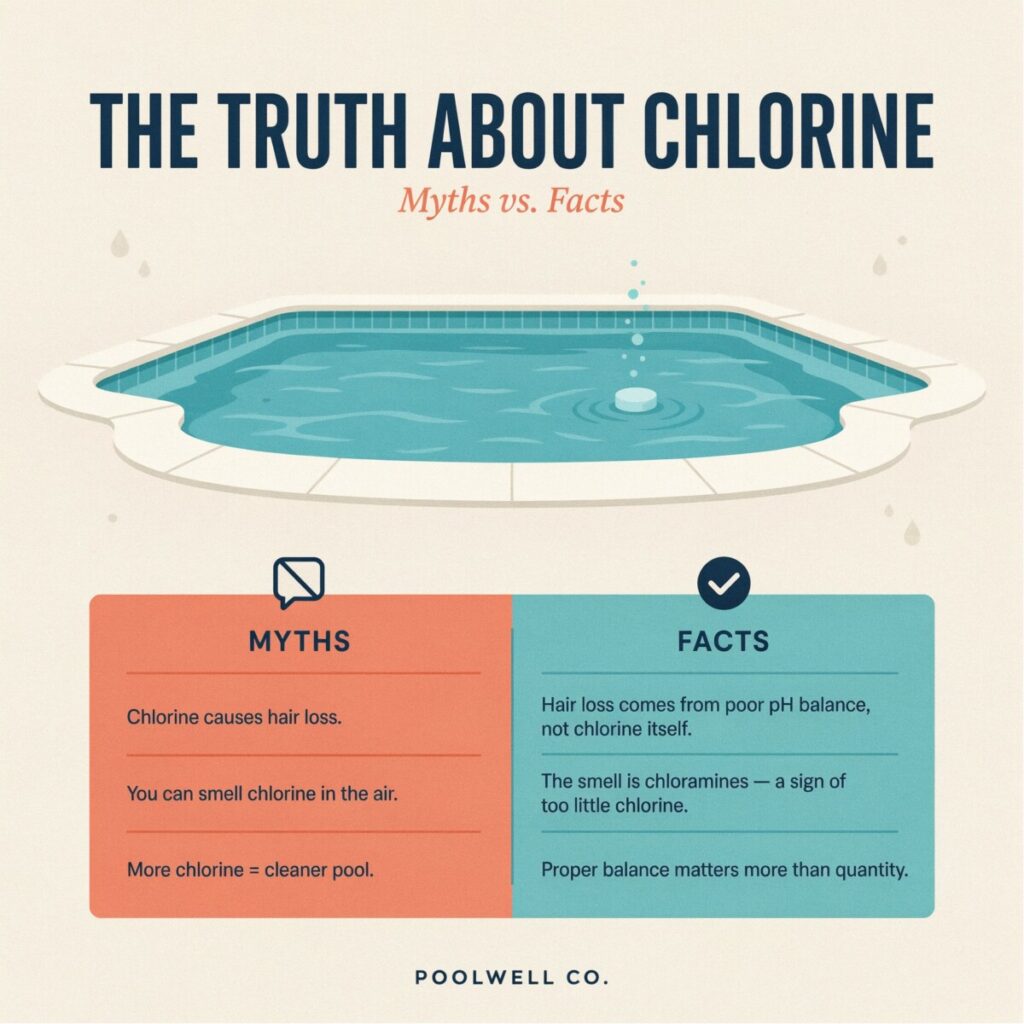
Myths vs. Facts: 8 Common Chlorine Claims, Debunked
Myth #1: “Chlorine in pools causes cancer.”
The claim usually hinges on the idea that any chemical in a pool must be carcinogenic, especially when swimmers swallow small amounts of water. In reality, the chlorine levels maintained in properly operated pools — typically 1.0 to 3.0 parts per million (ppm) of free chlorine — are well within ranges that decades of epidemiological research have not linked to cancer in swimmers (CDC, 2023). What has drawn scientific scrutiny are disinfection byproducts (DBPs), which form when chlorine reacts with organic matter like sweat, urine, or skin cells. Some DBPs, such as trihalomethanes (THMs), have been associated with elevated cancer risk at high, long-term drinking water exposures — but the exposure pathway and dose for a recreational swimmer are very different.
Myth #2: “If I can smell chlorine, the water is too chlorinated.”
This is one of the most widespread misunderstandings in pool chemistry. That strong “pool chlorine smell” is almost never caused by too much chlorine — it’s caused by too little. When chlorine reacts with nitrogen-containing contaminants (sweat, urine, cosmetics), it forms compounds called chloramines. Chloramines are what you actually smell, and they are also the primary culprits behind red eyes and that sticky post-swim skin feeling (CDC, 2022). A well-maintained pool with adequate free chlorine and regular pool shock treatments should have almost no odor at all. So the smell is a warning sign, just not the one most people think.
Myth #3: “Drinking tap water with chlorine is dangerous long-term.”
The EPA sets a maximum residual disinfectant level (MRDL) for chlorine in drinking water at 4.0 milligrams per liter (mg/L), which is equivalent to 4.0 ppm (EPA, 2023). Most U.S. utilities keep levels well below that, often between 0.5 and 2.0 ppm. At these concentrations, the health risk from chlorine itself is considered negligible compared to the well-documented danger of untreated water. The more nuanced concern involves DBPs like THMs and haloacetic acids, for which the EPA also sets maximum contaminant levels (MCLs), currently 80 parts per billion (ppb) for total THMs. Utilities actively manage these byprecursor removal and alternative disinfectant strategies to stay in compliance.
Myth #4: “Chlorine and bleach are the same thing and equally toxic.”
The bleach vs. chlorine confusion is understandable, because household chlorine bleach is a chlorine compound — specifically, a dilute solution of sodium hypochlorite, usually 5% to 8%. But “chlorine” by itself refers to the chemical element (Cl), which as a pure gas is indeed extremely hazardous. In everyday use, though, we’re almost always talking about chlorine bound into stable compounds: sodium hypochlorite in bleach, calcium hypochlorite in pool tablets, or dissolved gas in municipal water. Toxicity depends on form, concentration, and exposure route. A splash of diluted bleach on a counter is a very different risk profile than inhaling concentrated chlorine gas (CDC, 2021).
Myth #5: “Chlorine alone is enough to keep pools completely safe.”
Chlorine is the workhorse of pool sanitation, but it is not a magic bullet. Cryptosporidium, a tough protozoan parasite, can survive for days in properly chlorinated water, which is why CDC recommends supplemental measures like UV or ozone systems for high-risk venues (CDC, 2023). Effective pool maintenance also depends on complementary factors: proper pH (7.2 to 7.8) dramatically affects chlorine’s killing power, filtration removes particles that harbor germs, and regular shocking oxidizes built-up organics. Think of chlorine as one essential leg of a three-or-four-legged stool.
Myth #6: “Showering after swimming won’t reduce chlorine exposure.”
A post-swim shower absolutely helps, and it serves two purposes. First, it rinses off chloramines and residual chlorine from the skin and hair, reducing irritation and that “swimmer’s itch” some people report. Second — and this is the public-health angle — a pre-swim shower rinses off sweat, cosmetics, and personal care products before they enter the pool, which directly reduces the formation of chloramines and helps swimmers reduce chlorine smell at the facility (CDC, 2022). Studies on chlorine exposure show that even a 60-second rinse significantly lowers the contaminant load entering the water.
Myth #7: “Chlorine harms aquatic life the same way it harms humans.”
Aquatic organisms are, in fact, more sensitive to chlorine residuals than humans are — which is exactly why municipal wastewater plants are required to dechlorinate their effluent before releasing it into rivers and streams. Free chlorine is toxic to fish at concentrations as low as 0.02 ppm, so treatment plants typically use sulfur dioxide, sodium bisulfite, or simply extended retention times to bring residuals below detection before discharge (EPA, 2022). The “same way” framing is misleading: fish gills extract chemicals directly from water, a very different exposure route than human skin contact or ingestion.
Myth #8: “Natural alternatives (like salt, UV, or ionizers) are always safer than chlorine.”
“Saltwater” pools are a particularly common misunderstanding. The salt is electrolyzed on-site to produce chlorine — so a saltwater pool is still a chlorine pool, just with a different delivery method. UV and ozone systems do reduce the amount of chlorine needed, which is a real benefit, but neither provides the lasting residual that protects water while swimmers are in it. EPA chlorine guidelines and most state health codes still require a measurable residual disinfectant in public pools, which means chlorine or bromine stays in the system (EPA, 2023). “Always safer” overstates the case; “often complementary” is more accurate.
Health and Safety: What the Evidence Actually Shows
Short-term chlorine exposure at typical pool and tap levels most commonly shows up as mild irritation: red eyes, dry or itchy skin, a scratchy throat, or a runny nose. These symptoms are often driven more by chloramines and poor ventilation (especially at indoor pools) than by chlorine itself. For people with asthma or other respiratory conditions, indoor pool air can be a trigger, which is why competitive swimmers and lifeguards sometimes report exercise-induced bronchospasm more often than the general public (CDC, 2022).
Long-term health questions center primarily on DBPs in drinking water. Large epidemiological studies have found associations between long-term consumption of water with elevated THMs and small increases in bladder cancer risk, though the evidence remains mixed and the absolute risk is small at regulated levels (WHO, 2021). Vulnerable populations — young children, pregnant people, and those with chronic respiratory disease — may choose additional precautions: letting kitchen tap water run for 30 seconds before drinking, using an activated-carbon pitcher filter certified to reduce chlorine and THMs (look for NSF/ANSI Standard 53 or 42), and making sure indoor pool areas are well ventilated.
As a practical frame of reference, free chlorine levels between 1.0 and 3.0 ppm in pools and 0.5 to 2.0 ppm in tap water are routine operating ranges, well within chlorine safety margins set by federal regulators. Staying within them — and maintaining pH in the 7.2 to 7.8 window where chlorine works best — is the single most impactful thing a pool owner or homeowner can do.
Environmental Impact: What Leaves the Pool and the Tap
When pool water is drained or backwashed, and when treated wastewater is released, whatever is in it eventually reaches a river, lake, or estuary. Free chlorine and chloramines are toxic to fish and invertebrates at very low concentrations, which is why dechlorination before discharge is a standard, legally required practice at wastewater facilities (EPA, 2022). Many modern plants now use UV disinfection as a polishing step, which reduces both chlorine demand and DBP formation in the effluent — a practical example of how treatment innovation addresses environmental concerns.
For homeowners, the rule of thumb is simple: never drain a freshly shocked pool into a storm drain, creek, or street gutter. Let chlorine levels fall below 0.1 ppm (test with a kit) or dechlorinate with a commercial neutralizer before draining to a sanitary sewer where permitted. Pouring large volumes of undiluted bleach down household drains can also disrupt septic systems and municipal biological treatment, so follow label disposal guidance.
A Practical Pool-Owner Checklist
Use this as a quick reference for routine pool maintenance and swimming and health-conscious habits:
- Test free chlorine and pH at least 2–3× per week during swim season (daily for heavy-use pools).
- Target ranges: free chlorine 1.0–3.0 ppm; pH 7.2–7.8; combined chlorine (chloramines) below 0.2 ppm.
- Shock the pool when combined chlorine exceeds 0.5 ppm, after heavy rain, or after a big pool party.
- Run the filter 8–12 hours daily to keep water circulating and clear.
- Encourage pre-swim showers to reduce chloramine formation and reduce chlorine smell.
- Store chemicals in a cool, dry, ventilated area — never mix chlorine products with acid or ammonia.
- Ventilate indoor pools aggressively; if you smell chloramines strongly, something needs adjusting.
- Call a professional if water stays cloudy, chlorine demand spikes, or you spot algae that won’t clear.
A Quick Case Study: The Parent Who Learned to Test
Sarah, a mom of two in suburban Ohio, used to pull her kids out of the community pool the minute she caught that sharp chemical smell. “It just felt wrong,” she told us. After reading a CDC fact sheet on chloramines, she bought a $12 test strip kit, checked the pool at her next visit, and discovered free chlorine was actually on the low side — the smell was chloramines from a busy Saturday crowd. She brought it up with the pool manager, who adjusted the shock schedule, and she now uses the same strips at home. The lesson: a small investment in testing replaces a lot of guessing about chlorine in pools.
Myth-Busting FAQ
Is it safe to drink tap water with chlorine? Yes, within regulated levels. Most U.S. tap water is well below the EPA’s 4.0 ppm MRDL for chlorine.
Does chlorine bleach kill viruses on surfaces? Yes. A diluted bleach solution (per CDC guidance) is effective against most viruses and bacteria on hard, non-porous surfaces.
Can I swim if I’m pregnant? Generally yes, at properly maintained pools. If you’re concerned about DBPs, prefer outdoor or well-ventilated pools and keep sessions moderate.
Why do my eyes burn in the pool? Usually chloramines, not high chlorine. It’s a sign the water chemistry needs attention.
Do saltwater pools have no chlorine? They do — the salt cell generates chlorine on-site. They’re still chlorine pools, just with a different delivery system.
Can I mix bleach and vinegar for cleaning? Absolutely not. This combination produces chlorine gas, which is dangerous to inhale.
How do I reduce chlorine taste in drinking water? Refrigerate an open pitcher of tap water overnight, or use an activated-carbon filter certified to NSF/ANSI 42.
Does boiling water remove chlorine? It will drive off dissolved chlorine gas, but it does not remove chloramine and can actually concentrate DBPs.
The Bottom Line
Chlorine isn’t perfect, but it quietly protects millions of Americans from waterborne illness every single day. Most of our fears about it are based on misunderstandings — and most of the real risks are manageable with a test strip and good ventilation. Three things you can do today: (1) buy a simple pool and tap water test kit, (2) take a 60-second pre-swim shower at any pool you visit, and (3) if an indoor pool smells strongly of “chlorine,” mention it to the operator — it’s usually a sign the water needs attention, not that it’s dangerous.