Picture this: It’s a blazing Saturday afternoon in July. The kids are begging to swim, but you’re stuck outside with a test kit, a bucket of chlorine tablets, and that all-too-familiar sting in your eyes. Sound familiar? For millions of American pool owners, the weekly chlorine ritual is a love-hate relationship — mostly hate.
That frustration is exactly what’s pushing more homeowners toward saltwater pools. But here’s the thing a lot of people get wrong: a saltwater pool isn’t a chlorine-free pool. It’s a different way of making chlorine, and that distinction changes everything about how you maintain your water. If you’ve been wondering whether to make the switch — or you already have a saltwater pool and feel like you’re flying blind — you’re in the right place.
In this guide, we’ll break down exactly how saltwater pool maintenance differs from traditional chlorine pool care, walk you through a practical seasonal checklist, troubleshoot the most common headaches, and give you an honest look at costs. Let’s dive in.
What Is a Saltwater Pool, Really?
A saltwater pool isn’t filled with ocean water. In fact, the salt concentration is surprisingly low — typically between 2,700 and 3,400 parts per million (ppm). For comparison, the ocean sits around 35,000 ppm. Your saltwater pool is closer to the salinity of a human teardrop, which is why the water feels noticeably softer on your skin and eyes.
The magic happens inside a device called a salt chlorine generator (also known as a salt cell or saltwater chlorinator). Here’s the short version: you dissolve pool-grade salt into the water, and as that saltwater flows through the generator’s cell, a process called electrolysis splits the salt (sodium chloride) molecules and produces hypochlorous acid — the exact same sanitizing compound you’d get from liquid chlorine or chlorine tablets.
So yes, a saltwater pool is a chlorinated pool. The difference is that instead of buying, storing, and manually dosing chlorine, your pool produces its own chlorine continuously whenever the pump is running. The salt itself doesn’t get “used up” in the process — it gets converted to chlorine, does its sanitizing job, and then reverts back to salt. It’s a remarkably efficient loop.
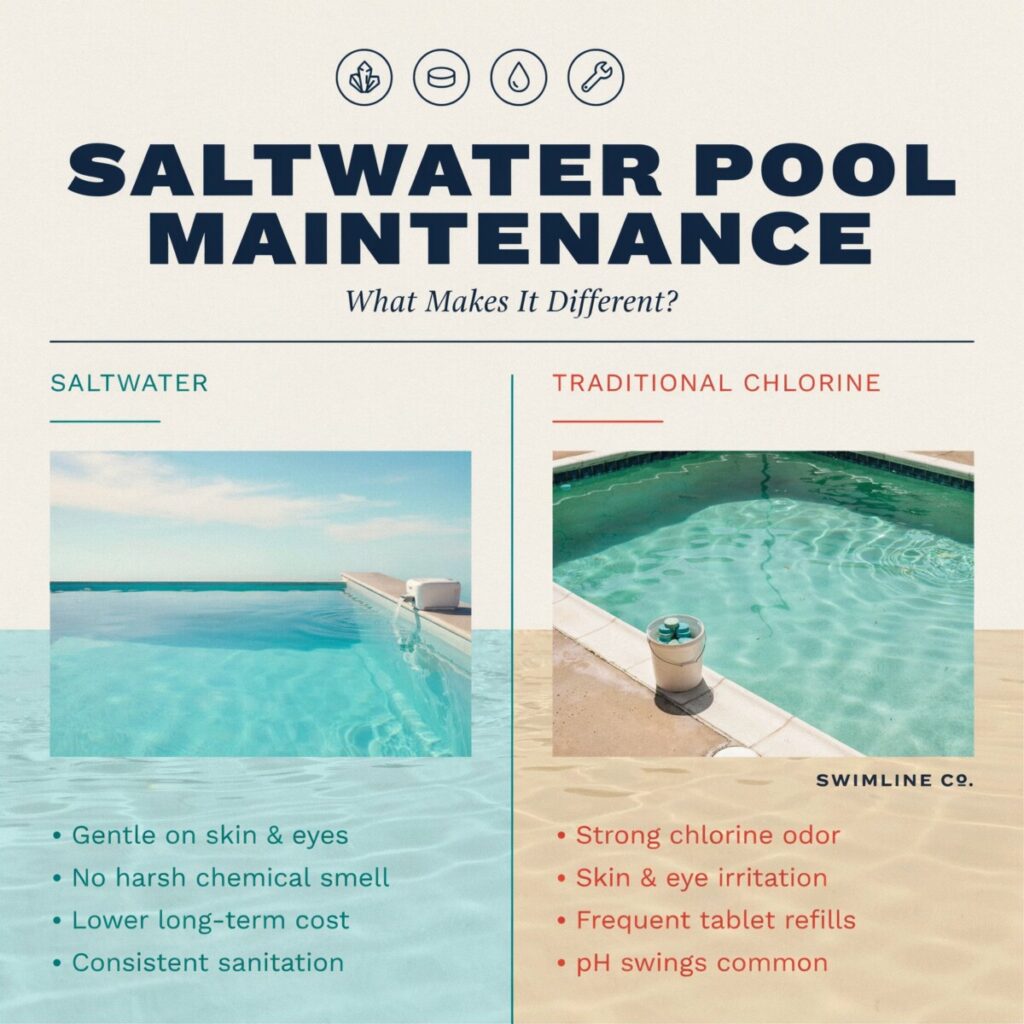
The result? Water that feels silkier, smells less like a public swimming facility, and doesn’t leave your kids with red eyes and bleach-faded swimsuits. But “easier” doesn’t mean “effortless,” and that’s where a solid understanding of saltwater pool maintenance becomes essential.
How Saltwater Systems Work vs. Traditional Chlorine
To appreciate why saltwater pool maintenance is different, it helps to understand the mechanics side by side.
The Traditional Chlorine Approach
With a conventional chlorine pool, you’re the manufacturer, delivery driver, and quality-control manager all rolled into one. You buy chlorine in some form — liquid bleach, trichlor tablets, cal-hypo granules — and you add it to the water on a regular schedule. Tablet feeders and floating dispensers automate this somewhat, but you’re still responsible for testing, dosing, and adjusting. When the chlorine level drops (and it always drops, especially in summer heat and sunlight), you manually shock the pool to bring it back up.
Every chlorine product you add also introduces secondary chemicals. Trichlor tablets, for example, add cyanuric acid (CYA) to the water. Over a season, CYA can climb so high that it “locks” your chlorine, making it ineffective — a problem known as chlorine lock or over-stabilization. At that point, your only fix is partially draining and refilling the pool.
The Salt Chlorine Generator Approach
A saltwater system flips the model. The salt chlorine generator consists of two main components: a salt cell (the chamber where electrolysis happens) and a control unit (the brain mounted near your equipment pad that lets you set chlorine output levels). As pool water passes through the cell, titanium-coated plates inside are charged with electricity, triggering electrolysis. The system continuously converts dissolved salt into free chlorine at a rate you control.
This means your chlorine production is steady and automatic. No more wild swings between “way too much chlorine” (right after you shock) and “way too little” (three days before you shock again). Your sanitizer level stays in a tight, consistent range, which is better for your skin, your swimsuit, and your pool equipment.
However — and this is critical — the salt cell is a consumable part. The titanium plates inside degrade over time. Most salt cells last 3 to 5 years, depending on usage, water chemistry, and how well you maintain them. Replacement cells typically cost $400 to $700, which is an ongoing expense traditional chlorine pools don’t have. On the flip side, you’ll stop buying chlorine tablets and liquid shock almost entirely, which offsets that cost substantially.
One more thing: because electrolysis produces chlorine and sodium hydroxide as a byproduct, saltwater pools naturally experience rising pH levels. This is the single biggest day-to-day maintenance difference, and we’ll talk about how to manage it in the checklist below.
Maintenance Differences at a Glance: Saltwater vs. Chlorine
If you’re considering a switch or just want to understand what you’ve signed up for, here’s a high-level comparison of how saltwater pool maintenance stacks up against traditional chlorine pool care.
| Task | Traditional Chlorine Pool | Saltwater Pool |
|---|---|---|
| Sanitizer delivery | Manual dosing (tablets, liquid, granules) | Automatic via salt chlorine generator |
| Chlorine testing | 2–3 times per week | 1–2 times per week |
| pH management | Fluctuates; acid and base needed | Trends upward; acid additions more frequent |
| Salt testing | Not applicable | Monthly (or after heavy rain/splash-out) |
| Shocking | Weekly or biweekly | Less frequent; generator handles routine demand |
| Salt cell maintenance | Not applicable | Inspect and clean every 60–90 days |
| CYA management | Builds up from stabilized chlorine | More stable; added manually, less frequent top-off |
| Seasonal startup/winterizing | Standard | Standard + salt cell removal and storage |
The biggest shift when you convert to a saltwater pool is psychological as much as it is practical. You stop thinking about adding sanitizer and start thinking about maintaining the machine that makes your sanitizer. Your salt cell becomes the heart of your system, and keeping it clean and functioning properly is the single most important thing you can do.
Your Practical Saltwater Pool Maintenance Checklist
Alright, let’s get into the nuts and bolts. Below is a step-by-step, seasonally organized checklist that covers everything a residential pool owner needs to know. Bookmark this section — you’ll come back to it.
Weekly Tasks
- Test your water. Use a reliable liquid test kit (strip tests are okay for quick checks, but liquid reagent kits are more accurate). Test for:
- Free chlorine: Target 1–3 ppm
- pH: Target 7.2–7.6 (remember, saltwater pools trend upward)
- Total alkalinity: Target 80–120 ppm
- Salt levels: Target your manufacturer’s recommended range (usually 2,700–3,400 ppm) — test weekly at first, then monthly once levels stabilize
- Adjust pH as needed. Muriatic acid (diluted hydrochloric acid) is your go-to for lowering pH. Many saltwater pool owners add a small dose of acid weekly. Always add acid to water, never water to acid.
- Check your salt chlorine generator display. Confirm the unit is producing chlorine (most displays show a percentage output and current salt reading). If the “low salt” or “check cell” light is on, address it promptly.
- Brush pool walls and steps. Algae loves to cling to surfaces, and brushing disrupts it before it can establish. Pay extra attention to corners, ladders, and light niches.
- Run your pump. Ensure your pump runs long enough for the salt cell to produce adequate chlorine. Most saltwater pools need 8–12 hours of pump runtime during peak swimming season.
- Skim and empty baskets. Leaf skimmer, pump basket, and filter pressure — quick checks that keep everything flowing.
Real-world example: Sarah, a homeowner in Tampa, switched to a saltwater pool and was thrilled with the softer water — until she noticed her pH climbing to 8.0+ every week. She didn’t realize that rising pH is a built-in feature of electrolysis. Once she started adding a cup of muriatic acid weekly, her water stayed balanced and her salt cell stopped scaling up.
Monthly Tasks
- Deep-test your water. Beyond the weekly basics, check:
- Calcium hardness: Target 200–400 ppm (critical for preventing corrosion and scaling)
- Cyanuric acid (CYA): Target 60–80 ppm for saltwater pools (higher than traditional pools because outdoor UV degrades chlorine faster, and salt systems produce chlorine at a lower rate)
- Metals (iron, copper): Especially important if you have well water or notice staining
- Inspect the salt cell. Shut off power, remove the cell, and visually inspect the plates for calcium scaling (white, crusty buildup). If you see buildup, it’s time for a cleaning (see below).
- Clean the salt cell (as needed, typically every 60–90 days):
- Turn off power to the generator and pump.
- Remove the cell from the plumbing.
- Mix a solution of 1 part muriatic acid to 4 parts water in a bucket.
- Submerge the cell for 15–20 minutes (don’t exceed 20 minutes).
- Rinse thoroughly with a garden hose.
- Reinstall and restore power. Never use a wire brush or screwdriver to scrape scale off the plates — you’ll damage the titanium coating.
- Backwash or clean your filter. Check your filter pressure gauge; backwash (sand/DE) or clean cartridges when pressure rises 8–10 psi above clean pressure.
- Check pool equipment for corrosion. Inspect ladders, handrails, light fixtures, and any metal components near the pool. Salt, even at low concentrations, accelerates corrosion of untreated metals.
Seasonal Tasks
Spring / Summer Prep:
- Test and balance all water chemistry parameters before opening.
- Add salt if levels dropped over the winter (splash-out, backwashing, and rain dilute salt concentration).
- Inspect the salt cell for winter damage; clean if needed.
- Increase pump runtime as temperatures climb and bather load increases.
- Ensure CYA is in the 60–80 ppm range — UV intensity in summer will destroy chlorine faster than your cell can produce it if CYA is too low.
Fall / Winter Prep (relevant for freezing climates — Northeast, Midwest, Mountain West):
- Lower water level below the skimmer and return jets.
- Remove the salt cell entirely. Drain it, let it dry, and store it indoors. Freezing water inside the cell will crack the housing — a $500+ mistake.
- Install a dummy cell or winterizing plug in the cell’s plumbing position.
- Add a winter algaecide and cover the pool.
- If you live in a mild climate (Southern California, South Texas, Florida), you may keep the system running year-round but reduce pump runtime and chlorine output during cooler months.
Pool Winterizing Tip: Always refer to your salt chlorine generator manufacturer’s specific winterizing instructions. Hayward, Pentair, and Jandy all have slightly different recommendations for their systems.
Troubleshooting Common Saltwater Pool Issues
Even with perfect maintenance habits, problems pop up. Here’s how to handle the most common saltwater pool troubleshooting scenarios.
Cloudy Water
Likely causes: Low chlorine, high pH, poor filtration, or high bather load.
Fix: First, verify your salt cell is actually producing chlorine (check the display). If chlorine is low, bump up the output percentage or manually shock the pool with a non-chlorine shock (potassium monopersulfate) or a chlorine shock (cal-hypo). Check and clean your filter. Make sure pH is below 7.8 — high pH causes cloudiness by making chlorine less effective and promoting calcium precipitation.
Low Chlorine Production
Likely causes: Salt level too low, dirty salt cell, cell reaching end of life, pump runtime too short, or water temperature below 60°F (most cells shut off in cold water to protect themselves).
Fix: Test salt levels and add salt if below the manufacturer’s minimum (usually around 2,500 ppm). Clean the cell. If the cell is more than 4–5 years old and you’ve been cleaning it regularly but output is still low, it’s probably time for a salt cell replacement. Increase pump runtime during hot weather.
Salt Cell Scaling or “Check Cell” Light
Likely causes: High calcium hardness, high pH, or infrequent cell cleaning.
Fix: Perform an acid wash on the cell (see monthly tasks above). Bring calcium hardness down to 200–400 ppm if it’s high. Lower pH. Consider adding a scale inhibitor (sequestrant) to your water if scaling is a recurring issue, especially in hard-water regions like the Southwest.
Corrosion of Metal Fixtures
Likely causes: Salt concentration too high, stray electrical current, or use of non-pool-grade salt containing impurities.
Fix: Test salt levels and dilute if above 3,500 ppm (partially drain and refill). Ensure your pool is properly bonded and grounded — hire a licensed electrician if you suspect stray current. Always use 99%+ pure sodium chloride (pool-grade salt), never rock salt or water-softener salt, which contain anti-caking agents and minerals that cause staining and corrosion.
Staining on Pool Surfaces
Likely causes: Undissolved salt sitting on the pool floor, metals (iron/copper) in the water, or organic debris.
Fix: When adding salt, broadcast it across the deep end and brush the pool immediately to help it dissolve. For metal stains, test for iron and copper; treat with a metal sequestrant or ascorbic acid treatment. Organic stains (leaves, berries) usually respond to direct application of chlorine (a chlorine “tab” rubbed on the stain).
Mini case study: Mike in Arizona added four bags of salt to his pool on a Friday, then left for the weekend without brushing or running the pump. By Monday, he had pale, chalky stains across his plaster floor where the salt had settled and sat undissolved. A thorough brushing and a mild acid wash resolved it, but it was a preventable headache. Always brush after adding salt.
Algae Blooms
Likely causes: Inadequate chlorine production (cell output too low, cell failing, or pump not running enough), low CYA, or poor water circulation.
Fix: Superchlorinate using your generator’s “super chlorinate” or “boost” mode (if available) and supplement with a manual chlorine shock to 10+ ppm. Brush all surfaces aggressively. Run the pump 24 hours until the algae is dead and the water clears. Vacuum dead algae to waste if possible. After clearing, review your cell output settings and pump schedule to prevent recurrence.
When to call a pro: If you’ve followed the troubleshooting steps above and the problem persists — especially recurring algae, persistent cloudiness, or electrical issues — it’s time to contact a licensed pool service technician. Some problems (like a cracked salt cell housing, a failing control board, or a bonding/grounding fault) require professional diagnosis.
Costs, Pros and Cons, and Long-Term Considerations
Let’s talk money and trade-offs honestly.
Upfront Conversion Cost
Converting a traditional chlorine pool to a saltwater system typically costs $1,500 to $2,500 for a professional installation, including the salt chlorine generator, salt cell, control unit, plumbing modifications, and initial salt. DIY conversion kits are available for $800 to $1,500 if you’re comfortable with basic plumbing and electrical work (though the electrical connection should be done by a licensed electrician to meet code and maintain your warranty).
Ongoing Costs
- Pool salt: A 40-lb bag costs roughly $8–$15. Most pools need 4–8 bags at startup, then 1–3 bags per season for top-offs. Annual salt cost: $40–$100.
- Salt cell replacement: Every 3–5 years, $400–$700.
- Electricity: Salt cells draw minimal power (similar to a 100-watt light bulb). Negligible impact on your electric bill.
- Muriatic acid: $10–$15 per gallon; most pools use 1–2 gallons per month during swimming season. Annual cost: $60–$120.
- Chlorine (traditional pool comparison): $300–$600+ per year on tablets, liquid chlorine, and shock products.
When you do the math, saltwater pools typically save $200–$400 per year on chemical costs, which offsets the cell replacement expense and makes the total cost of ownership roughly comparable to — or slightly cheaper than — a traditional chlorine pool over a 10-year period.
Pros
- Softer, more comfortable water (less eye/skin irritation)
- Consistent chlorine levels (no more yo-yo sanitizer swings)
- Reduced chemical handling and storage (no more hauling chlorine jugs)
- Less chloramine buildup (fewer “pool smell” complaints)
- Potentially higher home resale appeal
Cons
- Higher upfront cost (generator and installation)
- Salt cell replacement every 3–5 years
- More frequent pH management (acid additions)
- Corrosion risk to metal fixtures, natural stone decking, and some pool equipment
- Salt can damage surrounding landscaping if water splashes out regularly
- Not ideal for pools with natural stone or soft coping materials (travertine, flagstone) unless sealed properly
Regional Considerations
- Southeast / Gulf Coast: High heat and humidity drive chlorine demand up; salt cells work overtime in summer. CYA management is critical.
- Southwest / Desert: Hard water makes calcium scaling on salt cells a frequent problem. A scale inhibitor is strongly recommended.
- Northeast / Midwest: Short swimming seasons mean less annual salt and cell wear, but winterizing is mandatory. Removing and storing the cell is non-negotiable.
- Pacific Northwest: Cooler temps may reduce cell output; shorter swim season offsets some costs.
Final Recommendations
Saltwater pools aren’t maintenance-free — but they are maintenance-different. The trade-off is straightforward: you give up the weekly ritual of adding chlorine and take on the responsibility of maintaining a piece of equipment that does it for you. For most homeowners, that’s a trade worth making.
Here’s what to take away:
- Test your water regularly. Consistent testing is the foundation of all pool care, saltwater or otherwise. Don’t skip it.
- Keep your salt cell clean. A scaled-up cell is an inefficient cell. Inspect and clean it every 60–90 days.
- Stay on top of pH. Rising pH is the #1 maintenance difference in saltwater pools. Keep acid on hand and dose weekly.
- Use only pool-grade salt. Impurities in cheap salt cause staining, scaling, and equipment damage.
- Schedule a professional inspection annually. A trained technician can spot early signs of cell degradation, corrosion, and equipment issues that DIYers often miss.
Ready to make your pool care easier? Save this article for reference, download our printable salt pool maintenance checklist to keep by your equipment pad, or contact a local pool professional to get a quote on installation, conversion, or a seasonal tune-up. Your future self — and your kids’ eyes — will thank you.