Your Pool Doesn’t Need a Full-Day Commitment — Just 30 Smart Minutes
It’s Thursday evening. The kids have been asking all week if they can swim Saturday afternoon, and you just got home from work. You glance out at the pool and wonder: Is it even ready? Maybe there are a few leaves floating on the surface, the water looks a little dull, and you can’t remember the last time you checked the chemicals. Sound familiar?
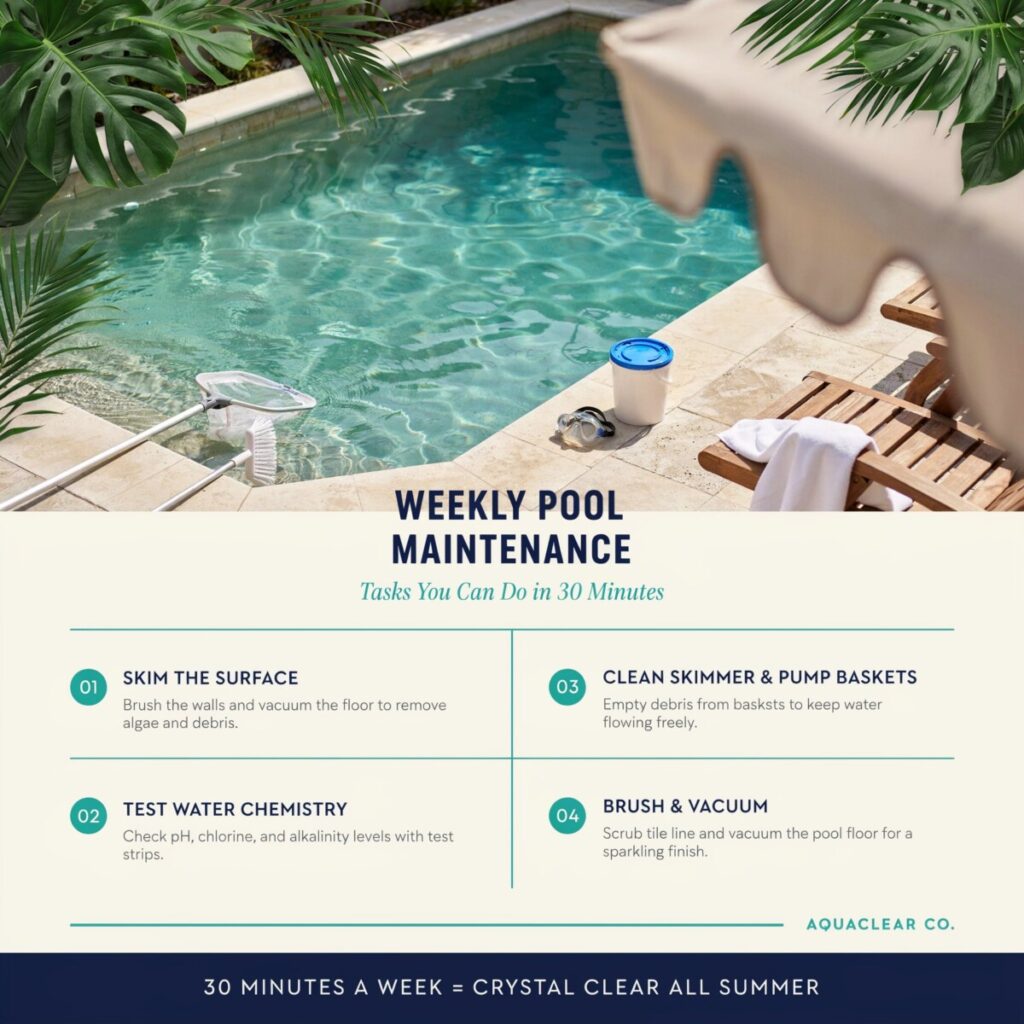
Here’s the good news: keeping a residential pool clean, safe, and swim-ready doesn’t require a full Saturday or an expensive weekly service contract. With a focused 30-minute pool routine, you can handle every essential weekly pool maintenance task yourself — even on the busiest schedule. This isn’t about perfection; it’s about consistency. A short, structured routine prevents algae, cloudy water, equipment damage, and those expensive emergency calls to a pool professional.
Whether you own an inground or above-ground pool, this guide gives you a realistic, step-by-step pool maintenance checklist you can complete in half an hour. We’ll walk through each task, explain why it matters, recommend the best pool maintenance tools, and share quick troubleshooting tips so nothing catches you off guard. Let’s get your pool swim-ready — one efficient half-hour at a time.
Why Weekly Pool Maintenance Matters
You might be tempted to skip a week (or two) when life gets hectic. After all, the water looks fine. But how to maintain a pool weekly is one of the most impactful things you can learn as a homeowner, and here’s why:
- Water clarity and comfort. Consistent skimming, brushing, and chemical balancing keep your water crystal clear and pleasant to swim in. Neglected pools turn cloudy, develop an unpleasant odor, and can irritate skin and eyes.
- Chemical balance and safety. Proper sanitizer levels destroy harmful bacteria and pathogens. The CDC notes that poorly maintained recreational water can spread illnesses — a risk no family wants.
- Equipment longevity. Your pump, filter, and heater work harder when baskets are clogged and water chemistry is off. Pool pump and filter maintenance done weekly can add years to expensive equipment.
- Cost savings. A single algae bloom can require hundreds of dollars in chemicals and hours of labor to fix. A green pool may even need a partial drain and refill. Quick pool maintenance prevents these costly emergencies.
- Algae prevention. Algae spores are always present. Regular brushing, sanitizing, and circulation are your best algae prevention strategy. Once algae takes hold, it spreads fast.
The bottom line: 30 minutes a week saves you weekends of frustration, protects your investment, and keeps your family safe.
Quick Prep: What You Need
Before starting your 30-minute pool routine, gather these essential pool cleaning tips and tools. Having everything within reach is the secret to staying under the 30-minute mark.
Essential tools and supplies:
- Telescoping pole (8–16 ft) — the backbone of your kit; attaches to most accessories
- Skimmer net (flat or deep leaf rake)
- Pool brush (nylon for vinyl/fiberglass; stainless steel for plaster only)
- Pool vacuum (manual head + hose) or automatic pool cleaner (suction-side, pressure-side, or robotic)
- Test strips or digital water tester
- Chlorine tablets, liquid chlorine, or alternative sanitizer (salt system, bromine, etc.)
- pH increaser (soda ash) and pH decreaser (muriatic acid or sodium bisulfate)
- Alkalinity adjuster and calcium hardness increaser
- Pool shock (calcium hypochlorite or non-chlorine shock)
Where to buy: Big-box stores (Home Depot, Lowe’s) carry solid basics at fair prices. Dedicated pool stores offer expert advice and professional-grade chemicals. Online retailers (Amazon, Pool Supply Unlimited, InyoPools) are great for bulk orders and equipment. For most residential pool maintenance, a hybrid approach works best — buy chemicals locally when you need them fast, and order tools online.
⚠️ Safety note: Always store pool chemicals in a cool, dry, well-ventilated area away from children and pets. Never mix chemicals together. Wear gloves and eye protection when handling muriatic acid or shock.
The 30-Minute Weekly Routine — Step by Step
This is the heart of your pool maintenance for busy homeowners. Each micro-task is timed so you stay on track. Put on a podcast, set a timer, and work through these steps in order.
⏱️ 0–3 Minutes: Visual Inspection and Pool Safety Check
Walk the entire perimeter of your pool and look around.
Why it matters: Catching problems early — a low water level, a pump that isn’t running, or a tear in your pool cover — prevents small issues from becoming expensive repairs.
How to do it:
- Check the water level — it should be about halfway up the skimmer opening. If it’s too low, your pump can run dry and burn out. If too high, the skimmer won’t work efficiently.
- Listen to the pump. It should sound steady and smooth, not grinding or struggling.
- Scan for floating debris, unusual color, or cloudiness.
- If you use a pool cover, check for standing water, tears, or sagging.
Quick tip: Top off water with a garden hose if it’s below the skimmer midpoint. If the pump sounds off, check the basket first (coming up next).
Common problem: Pump is off or making a loud humming noise.
One-line fix: Check the circuit breaker and GFCI outlet — a tripped breaker is the most common cause.
⏱️ 3–8 Minutes: Skim the Surface
Grab your telescoping pole and skimmer net and clear floating debris.
Why it matters: Leaves, bugs, and pollen sink and stain pool surfaces if left too long. They also consume chlorine as they decompose, throwing off your pool chemical balance.
How to do it:
- Use smooth, overlapping strokes across the surface, working from the downwind side toward you.
- For heavy leaf loads, switch to a deep leaf rake net — it holds more per scoop.
Quick tip: Skim before brushing and vacuuming. Removing surface debris first prevents it from sinking and settling on the floor during the rest of your routine.
Common problem: Debris keeps drifting back into the area you just skimmed.
One-line fix: Work with the wind, not against it, and skim toward the pool’s return jets which push debris to one side.
⏱️ 8–12 Minutes: Empty Skimmer and Pump Baskets
This is one of the most important — and most skipped — tasks in weekly pool maintenance.
Why it matters: Clogged baskets restrict water flow, strain your pump, and reduce filtration efficiency. This is core skimmer basket cleaning that keeps your system healthy.
How to do it:
- Turn off the pump at the breaker or timer before opening any basket.
- Open the skimmer lid(s) at the poolside, lift out the basket, dump debris into a trash bag, and rinse with a hose.
- Open the pump strainer pot (near the equipment pad), remove the basket, empty it, and check the O-ring for cracks. Lubricate it lightly with pool lube if it looks dry.
- Replace baskets, close lids, and restart the pump.
Quick tip: Keep a small trash bag hooked to the telescoping pole or nearby fence so you can empty baskets without walking to a distant garbage can.
Common problem: Pump won’t re-prime after opening the strainer pot.
One-line fix: Fill the pump strainer pot with water from a hose before restarting to help it re-prime.
⏱️ 12–17 Minutes: Brush Walls, Steps, and Waterline
Attach the pool brush to your telescoping pole and get to work.
Why it matters: Brushing dislodges algae spores and biofilm before they take hold. It’s the single most effective algae prevention step that chemicals alone can’t replace.
How to do it:
- Use firm, overlapping strokes from the deep end toward the shallow end and steps.
- Pay extra attention to corners, behind ladders, light niches, and the waterline tile where scale and biofilm build up.
- Match your brush to your surface: nylon bristles for vinyl and fiberglass, stainless steel for plaster only (never use steel on vinyl — it will tear it).
Quick tip: Brush toward the main drain so dislodged debris gets pulled into the filtration system rather than settling elsewhere.
Common problem: Stubborn brown or black stains on plaster walls.
One-line fix: These may be mineral stains or black algae — spot-treat with a chlorine tablet rubbed directly on the stain (plaster pools only) or use a stain eraser.
⏱️ 17–22 Minutes: Vacuum or Run Automatic Cleaner
Now it’s time for your pool brush and vacuum combo to finish the job.
Why it matters: Brushing loosens debris; vacuuming removes it. Skipping vacuuming means that debris settles, decays, and feeds algae.
How to do it:
- If you have a robotic cleaner: Drop it in during step 1 and let it run while you do other tasks. Retrieve it at the end.
- If you have a suction-side or pressure-side cleaner: Attach it and let it run for the week between maintenance sessions.
- If you vacuum manually: Attach the vacuum head and hose to the telescoping pole. Submerge the hose fully to prime it (remove air bubbles), then connect to the skimmer suction port. Vacuum in slow, overlapping rows like mowing a lawn.
Quick tip: For heavy debris on the pool floor, use the “waste” setting on your multiport valve instead of “filter” — this bypasses the filter and sends debris straight out the waste line (remember to add water afterward).
Common problem: Vacuum has weak suction or won’t pick up debris.
One-line fix: Check that the hose is fully primed (no air), the skimmer basket is empty, and no other suction lines (like a spa drain) are pulling flow away.
⏱️ 22–27 Minutes: Test Water and Adjust Chemicals
Pool water testing is where science meets simplicity.
Why it matters: Balanced water is safe, comfortable, and protects your pool surfaces and equipment. Unbalanced water causes cloudy water, scaling, corrosion, and skin irritation.
How to do it:
- Dip a test strip or fill your digital tester with a water sample from elbow depth, away from return jets.
- Compare readings against these target ranges:
| Parameter | Target Range |
|---|---|
| Free Chlorine | 1–3 ppm |
| pH | 7.2–7.6 |
| Total Alkalinity | 80–120 ppm |
| Calcium Hardness | 200–400 ppm |
| Cyanuric Acid (Stabilizer) | 30–50 ppm |
- Adjust in this order: alkalinity first, then pH, then chlorine. Alkalinity acts as a buffer for pH, so getting it right makes pH adjustments stick.
Quick tip: Add chemicals in small doses and retest after a few hours of pump circulation. Overcorrecting is a common beginner mistake.
Common problem: pH keeps bouncing back after you adjust it.
One-line fix: Your total alkalinity is likely too low or too high — correct alkalinity to 80–120 ppm first, then re-adjust pH.
⏱️ 27–30 Minutes: Final Equipment Check and Notes
Wrap up your 30-minute pool routine with a quick systems review.
Why it matters: A glance at your filter pressure gauge and pump tells you if anything needs attention before next week.
How to do it:
- Check the filter pressure gauge. Note the reading. When it rises 8–10 psi above the clean/startup pressure, it’s time to backwash (sand/DE filters) or clean the cartridges.
- Confirm the pump is running smoothly and all valves are in the correct position.
- Make a quick note on your phone: chemical doses added, anything unusual observed, and when your next shock treatment is due (typically every 1–2 weeks or after heavy rain/pool parties).
Quick tip: Take a photo of your pressure gauge reading each week. A quick visual log helps you spot trends and know exactly when to service your filter.
Common problem: Filter pressure is unusually high.
One-line fix: Backwash or clean the filter immediately, then record the new “clean” pressure as your baseline.
🏊 Sample 30-Minute Run-Through: It’s Monday evening. The kids want to swim Saturday. You walk out at 6:15 PM — water level looks good, pump is humming. You grab the pole and skim for five minutes, clearing a handful of oak leaves. You empty both baskets in four minutes, then spend five minutes brushing the steps and waterline tile. Your robotic cleaner is already cruising the floor. You test the water — pH is 7.8, so you add a measured dose of pH decreaser. Chlorine is at 2 ppm, perfect. You jot the filter pressure on your phone, and by 6:45 PM you’re back inside. Saturday swim? Sorted.
Your Printable Weekly Pool Maintenance Checklist
Copy, print, or screenshot this pool maintenance checklist and post it near your pool equipment:
- [ ] Walk perimeter — check water level, pump sound, and cover condition
- [ ] Skim surface with net — remove all floating debris
- [ ] Turn off pump, empty skimmer basket(s), empty pump strainer basket
- [ ] Restart pump and confirm normal operation
- [ ] Brush all walls, steps, corners, and waterline
- [ ] Vacuum manually or confirm automatic/robotic cleaner is running
- [ ] Test water — check free chlorine, pH, alkalinity, calcium hardness
- [ ] Add chemicals as needed (alkalinity → pH → chlorine)
- [ ] Note filter pressure gauge reading
- [ ] Record any observations or upcoming tasks (shock, backwash, etc.)
Quick Troubleshooting FAQ
Here are answers to the most common pool equipment troubleshooting and water quality questions busy homeowners face.
Q: The water turned cloudy after a big rainstorm. What do I do?
A: Storms dilute chemicals and introduce organic matter. Run the pump 24 hours, shock the pool, and retest chemistry. A clarifier can help the filter catch fine particles.
Q: I see green on the walls. Is that algae?
A: Likely yes. Green, yellow, or black patches that don’t brush off easily signal an algae bloom. Shock the pool immediately, brush aggressively, and run the filter continuously for 24–48 hours. For black algae, you’ll also need to scrub with a stainless-steel brush (plaster only) and an algaecide.
Q: I keep adding chlorine but the free chlorine level stays low. Why?
A: High levels of cyanuric acid (stabilizer) can “lock” chlorine, making it ineffective. If CYA is above 80 ppm, you may need to partially drain and refill. Also check for a high bather load or organics consuming chlorine.
Q: My pH is above 7.8. How do I lower it quickly?
A: Add muriatic acid or sodium bisulfate (dry acid) in small, measured doses with the pump running. Retest after 4–6 hours. Always add acid to water, never water to acid.
Q: The pump won’t prime — it’s running but no water is moving.
A: Check for air leaks at the pump lid O-ring, union fittings, and drain plugs. Fill the strainer pot with water, lubricate the O-ring, and restart. Persistent priming issues may indicate a suction-side leak that needs professional attention.
Q: When should I call a professional instead of DIY?
A: Call a licensed pool tech if you have persistent algae that won’t clear, a pump that won’t prime after troubleshooting, leaks you can’t locate, heater or electrical issues, or if you simply don’t have time to maintain the routine. There’s no shame in bringing in help for complex problems.
Seasonal Adjustments and Frequency Notes
Your seasonal pool maintenance needs shift throughout the year. Here’s how to adapt your 30-minute pool routine:
Peak swim season (late May–September in most US regions):
- Consider running the routine twice per week — especially after heavy pool parties, storms, or heatwaves.
- Shock the pool weekly or biweekly, and check chlorine more frequently in high heat.
Post-storm checklist:
- Remove large debris immediately, shock the pool, run the pump 24 hours, and retest all chemistry. Storms can dramatically shift pH and dilute sanitizer.
Fall and leaf season:
- Skim daily if possible, and consider a leaf net cover over the pool to reduce weekly debris load.
Winterizing (for seasonal pools in northern states):
- Your weekly routine transforms into a closing procedure: lower water, add winterizing chemicals, blow out lines, and install a winter cover. Consult a dedicated winterizing guide or hire a professional for your first closing.
Regional notes:
- Southern states (FL, TX, AZ, CA): Pools are often year-round. You’ll maintain a weekly routine 12 months a year, with increased attention during extreme heat.
- Northern and Midwest states: Typical swim season is May–September. Focus your weekly routine during open months and follow a proper opening/closing schedule.
Your Pool, Your 30 Minutes, Your Weekend Back
Consistent weekly pool maintenance doesn’t have to eat your life. In just 30 focused minutes, you can keep your water clean, your family safe, and your equipment running for years. The secret isn’t skill — it’s showing up every week, even if it’s just a quick pass before dinner on a Wednesday.
Ready to start? Download our free printable pool maintenance checklist [here], or drop a comment below with your pool type and biggest challenge — we read every one. If you’re dealing with stubborn water issues or equipment problems beyond this guide, reach out to a trusted local pool professional or visit the Pool & Hot Tub Alliance for certified resources in your area.
Your pool is waiting. 30 minutes. Let’s go. 🏊♂️