If you’ve ever heard someone say, “I switched to a saltwater pool because I don’t want chlorine anymore,” you’re not alone. It’s one of the most common misconceptions in the backyard pool world. The truth? Saltwater pools absolutely use chlorine — they just make it themselves, right in your equipment pad, instead of relying on you to lug jugs of liquid chlorine home from the store. In this deep dive, we’ll break down exactly how a saltwater chlorine generator works, why millions of US homeowners have made the switch, what maintenance really looks like, and whether one makes sense for your pool. No PhD required — just clear, practical explanations and actionable advice.
What Is a Saltwater Chlorine Generator?
A saltwater chlorine generator (sometimes called a salt chlorinator, salt chlorine generator, or simply a “salt cell”) is an electrochemical device that produces chlorine on-site by passing a low-voltage electrical current through slightly salty pool water. Think of it as a miniature chemical factory plumbed directly into your pool’s circulation system.
Let’s clear up the biggest myth right away: a saltwater pool is not a chlorine-free pool. The system generates the same active sanitizing compound — hypochlorous acid — that traditional liquid chlorine or chlorine tablets deliver. The difference is how that chlorine arrives in your water and what the overall swimming experience feels like.
Here’s why people choose them, in a nutshell:
- Softer, more comfortable water — The mild salt concentration (roughly one-tenth the salinity of the ocean) leaves skin and eyes feeling less irritated compared to traditionally chlorinated pools.
- Steadier chlorine levels — The system produces chlorine continuously while the pump runs, reducing the peaks and valleys that come with manual dosing.
- Less handling of harsh chemicals — You’re buying bags of inexpensive pool salt instead of storing, pouring, and transporting liquid chlorine or pucks.
The Science in Plain English: Electrolysis and Chlorine Production
At the heart of every saltwater pool system is a process called electrolysis — the same fundamental principle used in industrial chlor-alkali plants, just scaled down to fit beside your pool pump.
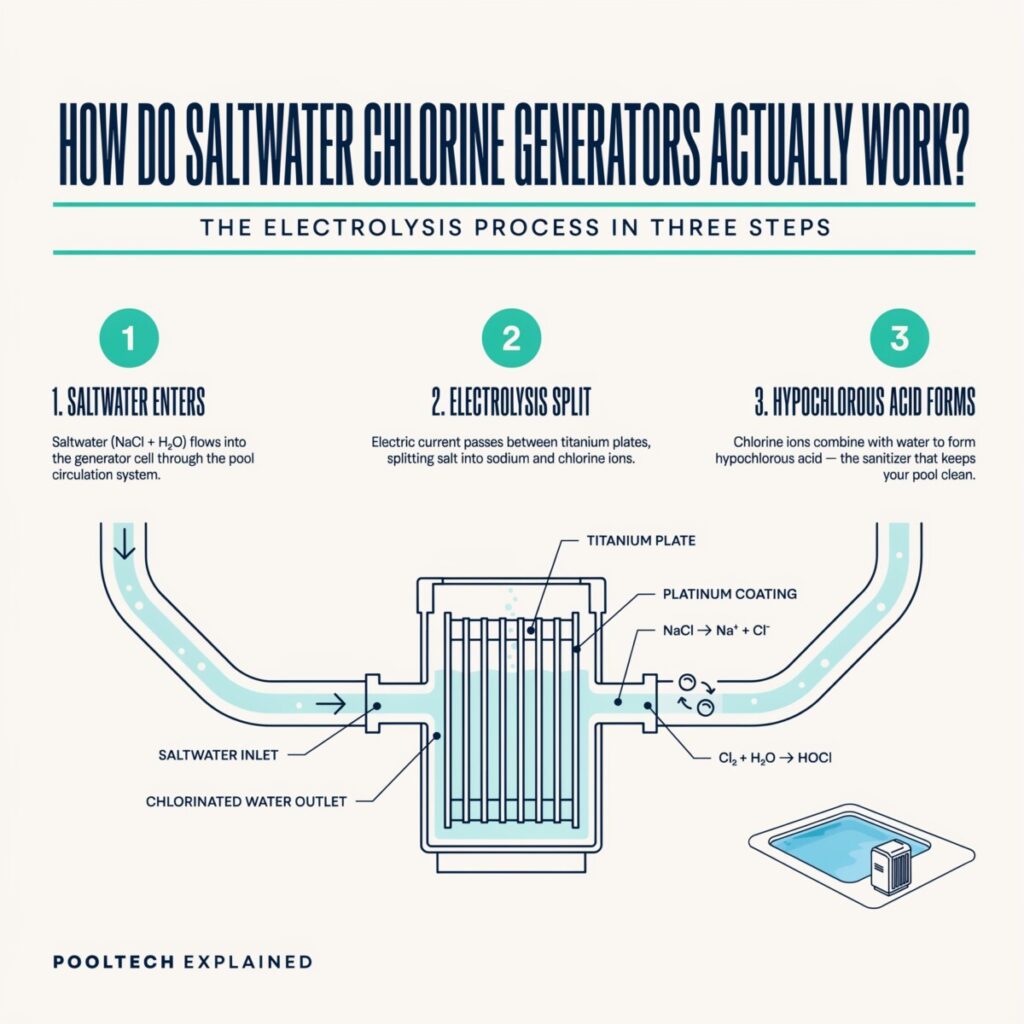
Here’s what happens in plain language. When you add pool-grade salt (sodium chloride, NaCl) to your water, it dissolves into sodium ions (Na⁺) and chloride ions (Cl⁻). As your pool pump pushes this mildly salty water through the salt cell, the cell’s electrically charged titanium plates split the compounds apart and recombine them into something new.
The chemistry, simplified:
- At the anode (positive plate): Chloride ions (Cl⁻) lose electrons and are oxidized into chlorine gas (Cl₂).
- At the cathode (negative plate): Water molecules gain electrons, producing hydrogen gas (H₂) and hydroxide ions (OH⁻).
- In the solution: The chlorine gas immediately reacts with the sodium hydroxide (NaOH) formed at the cathode, producing sodium hypochlorite (NaOCl) — the exact same active ingredient in household bleach and liquid pool chlorine.
- In the pool: Sodium hypochlorite dissolves and forms hypochlorous acid (HOCl), the actual sanitizer that destroys bacteria, algae, and organic contaminants.
A helpful analogy: Imagine a battery dipped in saltwater. The battery’s electrical energy acts like a chemical “scissors,” cutting apart salt and water molecules and rearranging the pieces into chlorine. Once that chlorine does its job sanitizing your pool, it eventually reverts back into chloride ions — essentially turning back into salt. It’s a beautifully efficient cycle.
How salty is the water? Most US residential saltwater pools operate at a salt concentration of roughly 2,700 to 3,400 parts per million (ppm). For reference, that’s about a tenth as salty as seawater (~35,000 ppm) and roughly similar to the salt content in a human teardrop. You’ll taste a faint saltiness, but it’s generally pleasant — most swimmers describe the water as feeling “silky” or “soft.”
Main Components of a Saltwater System
A complete saltwater chlorination setup isn’t just the cell itself. Here are the key components you’ll find in a typical US residential installation:
- Salt cell (electrolytic cell): The core of the system. Inside a cylindrical housing are a series of parallel titanium plates coated with a precious-metal catalyst (typically ruthenium or iridium oxide). These plates are where electrolysis actually happens. Cells are rated by their chlorine output, usually expressed in pounds of chlorine per day.
- Control unit (power supply/controller): A wall-mounted box that converts your household AC power into the low-voltage DC current the cell needs. It also houses the system’s brain — digital displays, output settings, diagnostic sensors, and sometimes Wi-Fi connectivity.
- Flow switch: A small sensor plumbed near the cell that detects whether water is actually flowing through the system. It’s a critical safety device — the controller won’t energize the cell without confirmed flow, preventing the unit from generating chlorine (and hydrogen gas) in a stagnant, potentially dangerous condition.
- Plumbing and bypass valve: The cell is plumbed into the return line (after the pump, filter, and heater). Many professional installations include a bypass valve setup, which lets you isolate the cell for maintenance or replacement without shutting down the entire circulation system.
- Salt (sodium chloride): Not a mechanical component, but an essential consumable. You’ll use high-purity pool salt (99%+ NaCl), typically sold in 40-pound bags. Avoid rock salt with anti-caking agents or iodized table salt, as impurities can stain surfaces or interfere with the cell.
How It Works Step-by-Step
Let’s walk through the entire chlorine production cycle from start to finish:
- Add salt to the pool. During initial setup, you’ll broadcast the required amount of pool salt directly into the water. For a typical 15,000-gallon residential pool at 3,000 ppm, that’s roughly 375–400 pounds of salt (about 9–10 bags). The pump circulates the water until the salt is fully dissolved — usually within 24 hours.
- Water circulates through the system. Your pool pump pushes water through the skimmer, filter, heater (if present), and finally through the salt cell on the return path to the pool.
- The flow switch activates. As water passes through the plumbing, the flow switch confirms adequate flow and sends a signal to the control unit: “Water is moving. It’s safe to energize the cell.”
- The control unit sends DC current to the cell. The power supply delivers a low-voltage direct current (typically 5–12 volts DC, depending on the model) to the titanium plates inside the cell.
- Electrolysis creates chlorine. As saltwater passes over the energized plates, the electrochemical reaction described earlier converts dissolved NaCl into sodium hypochlorite and hydrogen gas. You may notice fine bubbles coming from your return jets — that’s the hydrogen being safely expelled into the pool water and released into the atmosphere.
- Chlorine sanitizes the pool. The freshly generated sodium hypochlorite mixes into the pool water, forming hypochlorous acid that attacks bacteria, viruses, algae, and organic waste introduced by swimmers, rain, and debris.
- Chlorine reverts to salt. After the hypochlorous acid oxidizes contaminants, the chlorine atom picks up an electron and becomes a chloride ion again — essentially returning to its salt form. This is why saltwater pools don’t “use up” salt the way traditional pools use up chlorine. You only need to add more salt when water is lost to splash-out, backwashing, or rain dilution.
Typical control settings you’ll use:
- Output percentage: Most controllers let you dial the cell’s output from 0% to 100%. During peak summer swimming season, you might run at 60–80%; in cooler shoulder months, 20–40% may suffice.
- Pump timers: The cell only produces chlorine when the pump runs, so your filtration schedule directly controls chlorine production. Most US pool owners run their pump 8–12 hours per day during swimming season.
- Super chlorination (boost/shock mode): Many units offer a “super chlorinate” or “boost” function that runs the cell at 100% output for 24 hours. This is useful after heavy pool parties, major rainstorms, or when you spot early signs of algae — though for serious algae blooms, a traditional chlorine shock is usually faster and more effective.
Performance Factors and Troubleshooting
Saltwater chlorine generators are remarkably reliable, but they’re not maintenance-free. Several factors can throw the system off balance. Understanding them will save you time, money, and green-water headaches.
Common performance issues:
- Salt level too low or too high. If salt drops below the system’s minimum threshold (usually around 2,500 ppm), the cell will shut down or produce less chlorine. If it’s too high (above ~4,500 ppm for most units), the control board may flag an error, and the water can taste unpleasantly salty. The fix: test salt levels regularly with a digital salt meter or test strips, and add salt or partially drain-and-refill as needed.
- Low water flow. A clogged filter, blocked skimmer basket, or failing pump can reduce flow below the flow switch’s activation threshold, causing the cell to shut off. Check and clean your filter, empty baskets, and verify pump operation.
- Dirty or scaled cell. Calcium and mineral deposits can build up on the titanium plates over time, insulating them and dramatically reducing chlorine output. This is the number one cause of “my salt cell isn’t producing enough chlorine” complaints. We’ll cover cleaning in the maintenance section below.
- Incorrect pH. Electrolysis naturally drives pool pH upward (a byproduct of the sodium hydroxide generated at the cathode). If pH climbs above 7.8, chlorine becomes significantly less effective, and scaling accelerates. Most saltwater pool owners need to add muriatic acid (hydrochloric acid) regularly — often weekly — to keep pH in the ideal 7.2–7.6 range.
- Cyanuric acid (CYA) imbalance. CYA is a chlorine stabilizer that protects chlorine from UV degradation. Too little CYA (below 30 ppm), and sunlight destroys your chlorine before it can sanitize. Too much (above 80–100 ppm), and the chlorine becomes “locked” and ineffective. Target 50–70 ppm for outdoor saltwater pools.
- High total dissolved solids (TDS). Over time, minerals, bather waste, and chemical byproducts accumulate in pool water. When TDS gets too high (above ~3,000 ppm above your salt reading), water can become cloudy and chlorine less effective. A partial drain-and-refill resets TDS levels.
- Water temperature effects. Most salt cells reduce output or shut down entirely when water temperature drops below about 50–60°F (depending on the brand). This is a built-in protection — cold water slows the electrochemical reaction. In winter, you’ll likely need to supplement with traditional chlorine or close the pool.
- Power and electrical issues. Tripped GFCI breakers, corroded wiring connections, or voltage fluctuations can interrupt operation. Always check breakers and connections if the unit suddenly goes dark.
Practical troubleshooting checklist:
- Test salt level with a reliable digital meter (not just the unit’s built-in reading — these can drift over time).
- Inspect the cell visually by unscrewing it from the plumbing. Look for white, crusty calcium deposits on the plates.
- Clean the cell if needed (see maintenance section).
- Check the flow switch for debris or a stuck paddle.
- Verify pump operation and filter pressure.
- Test full water chemistry: pH, alkalinity, CYA, calcium hardness, and salt.
- Reset the control unit by powering it off for 30 seconds, then back on.
- Consult your owner’s manual for specific error codes — most modern units display clear diagnostic messages.
Maintenance, Lifespan, and Replacement
One of the most common questions from prospective buyers: how long does a salt cell last, and what does maintenance actually involve?
Salt cell lifespan: A typical salt cell will last 3 to 7 years, with most US homeowners seeing about 4–5 years of service. Lifespan depends heavily on:
- Usage intensity — A pool in Phoenix running 10 months a year will wear a cell faster than one in Minnesota used for 4 months.
- Water chemistry management — Consistently high pH, elevated calcium hardness, or improper salt levels accelerate plate degradation.
- Cleaning habits — Regular inspection and gentle cleaning extend cell life significantly.
- Brand and build quality — Premium cells with thicker ruthenium/iridium coatings tend to outlast budget options.
Cleaning frequency and method:
Inspect your cell every 4–8 weeks during swimming season, depending on your water’s calcium hardness. If you see light scaling, here’s the standard cleaning approach:
- Turn off power to the control unit at the breaker.
- Unscrew the cell from the plumbing union fittings.
- Rinse the plates with a garden hose to remove loose debris.
- If scaling remains, prepare a soaking solution of 4 parts water to 1 part muriatic acid (always add acid to water, never the reverse). Submerge the cell in a plastic bucket for 5–15 minutes. The acid will dissolve calcium deposits.
- Rinse thoroughly and reinstall.
Important: Never use a wire brush, screwdriver, or any metal tool to scrape the plates. The precious-metal coating is thin, and scratching it will permanently reduce the cell’s performance and lifespan.
Some manufacturers sell dedicated cell-cleaning acid kits with a threaded cap that seals one end of the cell, allowing you to soak it without removing it from the plumbing entirely. These are convenient and reduce the risk of cross-threading unions during reinstallation.
Signs your cell is nearing end of life:
- The control unit reports low salt even after you’ve confirmed proper levels with an independent test.
- Chlorine output drops noticeably, and you’re running the cell at 100% but still struggling to maintain 1–3 ppm free chlorine.
- Visible wear on the titanium plates — pitting, thinning, or loss of the dark coating.
- The cell has exceeded its rated operating hours (many manufacturers publish this figure).
Warranty notes: Most reputable brands offer 2–3 year warranties on salt cells, sometimes prorated after the first year. Keep your purchase receipt and register the product online to simplify warranty claims.
Seasonal considerations:
In colder US climates where pools are winterized, you should remove the cell, clean it, and store it indoors during the off-season. Freezing water inside the cell housing can crack the body and destroy the plates. Most manufacturers provide a winterizing cap or dummy cell that fits into the plumbing to keep debris out while the real cell is in storage. Even in warmer states like Florida or Southern California, salt cells typically reduce output or shut down when water temperatures drop below ~60°F, so supplemental chlorine may be needed during cool months.
Costs and Savings
Let’s talk dollars and cents — because a saltwater chlorine generator is an investment, and understanding the full financial picture helps you decide if it’s right for your situation.
Upfront costs (system + installation):
For a typical US residential pool (10,000–30,000 gallons), expect to pay roughly $900 to $2,500 for a complete saltwater system including the control unit, salt cell, flow switch, plumbing parts, and professional installation. The wide range reflects differences in:
- Brand and model tier (basic vs. Wi-Fi-enabled, self-cleaning, or integrated automation units)
- Cell output rating (higher-output cells cost more)
- Installation complexity (retrofitting an existing pool with new plumbing unions vs. including the system in a new pool build)
- Regional labor rates
If you’re a confident DIYer with plumbing and basic electrical skills, you can save $300–$600 on installation labor. However, many manufacturers require professional installation to honor the full warranty, and improper electrical work around a pool is a serious safety risk. When in doubt, hire a licensed pool professional or electrician.
Ongoing annual costs:
- Pool salt: After the initial fill, you’ll typically add 1–3 bags (40 lbs each) per season to replace salt lost to splash-out, backwashing, and rain overflow. At roughly $8–$12 per bag, this is $10–$40/year.
- Electricity: The cell draws modest power — roughly equivalent to running a 150–300 watt light bulb while the pump is on. At average US electricity rates, this adds approximately $50–$120/year to your electric bill, depending on pump runtime and local rates.
- Replacement salt cell: Budget for a new cell every 4–5 years. Replacement cells typically cost $350–$700, depending on the brand and output rating. Amortized over 5 years, that’s roughly $70–$140/year.
- Supplemental chemicals: You’ll still need muriatic acid (for pH control), CYA stabilizer, and occasional chlorine shock (especially after heavy use or algae scares). Budget $50–$150/year for these.
- Total estimated annual operating cost: $180–$450/year.
How does this compare to traditional chlorine?
A pool using liquid chlorine (sodium hypochlorite) typically requires 2–4 gallons of 10–12% liquid chlorine per week during peak season, at roughly $4–$8 per gallon. That’s $400–$1,600/year in chlorine alone, depending on pool size, climate, and bather load. Chlorine tablet (trichlor) users may spend $300–$800/year on tablets — but trichlor adds CYA with every dose, eventually requiring costly partial drain-and-refills when CYA accumulates too high.
ROI considerations:
The financial break-even point for a saltwater system versus liquid chlorine is typically 2–4 years for an average residential pool, depending on local chlorine prices, pool size, and how many months per year you swim. Beyond pure economics, many owners factor in the convenience of not hauling, storing, and handling harsh chemicals — a quality-of-life benefit that’s harder to quantify but very real.
Safety, Compatibility, and Myths
Let’s address some of the most persistent concerns and misconceptions head-on.
Myth: “Salt water is corrosive and will ruin my pool equipment.”
This is the single biggest objection to saltwater pools, and it deserves a nuanced answer. Salt can accelerate corrosion of certain metals — particularly untreated steel, aluminum, and copper — if salt levels are allowed to drift too high, if splash-out accumulates on metal surfaces, or if the pool’s bonding and grounding are inadequate. However, at the proper concentration (2,700–3,400 ppm), modern pool equipment (stainless steel heaters, polymer components, and properly coated metals) handles salt just fine. The key is management: keep salt levels within the recommended range, rinse metal handrails, ladders, and nearby stonework with fresh water periodically, and ensure your pool’s electrical bonding system meets current National Electrical Code (NEC) requirements.
Myth: “Saltwater pools are completely chemical-free.”
As we’ve covered, saltwater pools generate the same chlorine-based sanitizer as traditional systems. They are not chlorine-free, chemical-free, or “natural.” If a salesperson tells you otherwise, walk away.
Myth: “Salt cells don’t work in above-ground pools.”
They absolutely do. Many manufacturers offer compact salt chlorinators specifically designed for above-ground pools in the 5,000–15,000 gallon range. The same electrolysis principles apply.
Electrical safety:
A saltwater chlorine generator introduces electricity into your pool’s plumbing system, which makes proper installation critical. Key safety requirements include:
- The control unit must be connected to a GFCI-protected circuit (Ground Fault Circuit Interrupter).
- The pool’s equipotential bonding system must connect all metal components (pool shell rebar, ladders, handrails, light niches, pump, heater, and the salt cell housing) with a continuous copper bonding wire.
- Installation should comply with NEC Article 680 (Swimming Pools, Fountains, and Similar Installations) and local electrical codes.
- If you’re not experienced with pool electrical work, hire a licensed electrician. This is not an area for shortcuts.
Compatibility with pool types:
- Plaster/gunite/shotcrete pools: Fully compatible. Saltwater systems are extremely popular with plaster pools. Monitor calcium hardness to prevent plaster etching.
- Vinyl liner pools: Fully compatible. Salt does not harm vinyl. However, if the liner has any metal components (bolted walls, metal floor), ensure they’re protected from salt corrosion.
- Fiberglass pools: Fully compatible. Fiberglass is highly resistant to salt corrosion, making it one of the best pool surfaces for saltwater systems.
- Pool heaters: Most modern gas heaters with cupro-nickel or titanium heat exchangers are salt-compatible. Older heaters with copper heat exchangers may corrode prematurely. Check your heater’s manual.
- Pool covers: Automatic safety covers and solar covers are unaffected by salt. However, metal cover tracks and hardware should be rinsed periodically.
- Natural stone decks: Some soft stones (sandstone, certain limestones) can be etched by salt splash-out over time. Sealing the stone and rinsing the deck periodically helps prevent damage.
Choosing the Right System
Not all saltwater chlorine generators are created equal. Here’s how to match a system to your specific pool and needs.
Sizing: the most critical decision.
Salt cells are rated by their chlorine output in pounds per day (lbs/day) or by maximum pool gallon capacity. A common mistake is buying a unit rated exactly for your pool’s gallon count. This forces the cell to run at or near 100% output constantly, which shortens its lifespan.
Rule of thumb: Choose a cell rated for 1.5 to 2 times your pool’s actual gallon capacity. For example, if you have a 20,000-gallon pool, look for a system rated for 30,000–40,000 gallons (or roughly 1.0–1.5 lbs/day of chlorine output). This lets you run the cell at 50–70% output most of the time, extending its life and giving you headroom for peak-demand periods.
Quick buyer’s checklist:
- Rated output (lbs/day or gallons): Properly oversized for your pool volume.
- Cell warranty: Look for at least 2–3 years. Prorated warranties that drop sharply after year one are less valuable than flat warranties.
- Ease of cell replacement: Can you unscrew the cell without special tools? Are replacement cells readily available and reasonably priced?
- Control features: Digital display, adjustable output percentage, super chlorinate mode, self-cleaning reverse-polarity (which reduces calcium scaling), and diagnostic error codes.
- Smart connectivity: Wi-Fi or app control is increasingly common and genuinely useful for monitoring salt levels and adjusting output remotely — especially for vacation homes or rental properties.
- Dealer and manufacturer support: Is there accessible customer service? Are replacement parts easy to find? Check online reviews and pool forum discussions.
- Transparent cell housing: Some cells have clear bodies that let you visually inspect plate condition without removing the cell — a small but convenient feature.
Conclusion: Is a Saltwater Chlorine Generator Right for You?
Here’s the bottom line. A saltwater chlorine generator uses electrolysis to convert dissolved pool salt into chlorine — the same sanitizer you’d buy in a bottle, but produced fresh, continuously, and automatically right in your equipment pad. The result is a pool with steadier chlorine levels, more comfortable water, and less day-to-day chemical handling.
The tradeoffs are real: you’ll need to manage pH more actively (because electrolysis raises it), budget for eventual cell replacement every few years, invest in proper installation, and stay vigilant about salt levels and cell cleanliness. For most US pool owners who use their pool regularly and value convenience, the benefits outweigh the drawbacks — and the math typically pencils out within a few years compared to buying liquid chlorine or tablets.
Your next steps:
- Test your current water — Get a full panel (pH, alkalinity, calcium hardness, CYA, salt, and TDS) so you know your starting point.
- Consult a pool professional — Especially if you’re retrofitting an existing pool or need electrical work. A pro can recommend the right system size and handle installation safely.
- Compare top-rated models — Look at units from established brands, read owner reviews on pool forums, and match the system to your pool’s size and your comfort level with technology.
Whether you’re building a new pool or upgrading an existing one, a saltwater chlorine generator is one of the most impactful equipment choices you can make for a cleaner, softer, and more enjoyable swimming experience. Dive in — your eyes (and your wallet) will thank you.