Why Swimming Pool Chemistry Matters
Owning a pool is a dream come true for many homeowners, but it comes with a hidden responsibility: keeping the water safe and clean. If you ignore swimming pool chemistry, the consequences go far beyond a murky backyard eyesore. Poorly balanced water can cause severe skin and eye irritation, create a breeding ground for harmful bacteria, and trigger explosive algae blooms. Over time, unbalanced water also leads to pool equipment corrosion and staining, drastically shortening the lifespan of your expensive pump, heater, and pool surface.
On the flip side, mastering pool chemistry basics offers incredible benefits. Properly balanced water ensures a safe, comfortable swimming environment for your family. It protects your investment by extending the life of your pool’s interior finish and mechanical equipment, ultimately saving you thousands of dollars in long-term repair and replacement costs.
If you are feeling overwhelmed by the rows of colorful jugs at the pool supply store, take a deep breath. Beginner pool maintenance does not require a degree in chemistry. By the end of this guide, you will understand the key water tests, the purpose of common chemicals, and how to establish a simple, effective maintenance routine. Let’s dive in and learn how to balance pool water like a pro.
Pool Chemistry Basics: The Big Five
To achieve the perfect pool chemical balance, you need to monitor five primary parameters. Think of these as the vital signs of your pool.
1. pH: The Comfort and Efficiency Metric
pH measures how acidic or basic your water is on a scale of 0 to 14. For swimming pools, the ideal pool pH levels for swimming pools fall between 7.2 and 7.8.
If the pH drops too low (acidic), the water becomes corrosive, eating away at metal fixtures and plaster while stinging swimmers’ eyes. If it climbs too high (basic), the water becomes scale-forming, leading to cloudy water and crusty buildup. Crucially, high pH also dramatically reduces the sanitizing efficiency of your chlorine, meaning your pool could be unsafe even if your chlorine levels read normal.
2. Total Alkalinity (TA): The pH Shock Absorber
Total alkalinity measures the water’s ability to resist changes in pH. You can think of TA as the pool’s “shock absorber.” The ideal total alkalinity for pools is between 80 and 120 parts per million (ppm).
When TA is too low, your pH will bounce wildly—a phenomenon known as “pH bounce”—making it nearly impossible to keep the water balanced. When TA is too high, it locks the pH in place, making it incredibly difficult to lower the pH even when you add acid. Always adjust your TA before you attempt to adjust your pH.
3. Sanitizers: Free vs. Combined Chlorine
Chlorine is the most common pool water sanitizer. However, not all chlorine is created equal. Understanding free chlorine vs combined chlorine is essential.
- Free Chlorine (FC): This is the active, available chlorine ready to kill bacteria and algae. The ideal free chlorine level for a residential pool is
1to3ppm. - Combined Chlorine (CC): This is chlorine that has already bonded with contaminants (like sweat, urine, or dead algae). It is largely ineffective as a sanitizer and is responsible for that strong, unpleasant “pool smell.”
Total chlorine is simply the sum of free and combined chlorine. Your goal is to keep free chlorine high and combined chlorine as close to 0 ppm as possible.
4. Cyanuric Acid (CYA): The Sunscreen for Your Pool
Cyanuric acid, often called stabilizer, protects chlorine from being rapidly destroyed by the sun’s UV rays. It is an essential stabilizer for outdoor pools. The target cyanuric acid pool levels are 30 to 50 ppm.
While necessary, CYA is a double-edged sword. If levels creep above 80 ppm, it “over-stabilizes” the water, severely reducing chlorine’s killing power. Because CYA only leaves the pool through splashing, backwashing, or draining, it easily builds up over the season.
5. Calcium Hardness: Protecting the Surface
Calcium hardness measures the amount of dissolved calcium in the water. Proper pool calcium hardness levels (typically 200 to 400 ppm, depending on whether you have a plaster, fiberglass, or vinyl surface) prevent the water from leaching calcium out of your pool’s grout and plaster, which causes pitting and structural damage.
How These Parameters Interact
These five metrics do not exist in a vacuum. For example, low TA leads to pH swings, and high CYA reduces effective chlorine. Understanding these interactions is the secret to knowing how to balance pool water efficiently.
A Quick Note on Pool Volume and Dosing
Chemical dosing is entirely dependent on your pool’s volume. To calculate volume in gallons, use this basic formula for rectangular pools:
Volume=Length×Width×AverageDepth×7.48
Let’s look at a practical dosing example. Suppose you want to raise the free chlorine by 1 ppm. As a general rule, adding roughly 8.5 fluid ounces of 12.5% liquid chlorine per 10,000 gallons raises the FC by 1 ppm. If you have a 15,000-gallon pool, you scale the math:
15,000÷10,000=1.5
1.5×8.5 fl oz=12.75 fl oz
Note: Concentrations vary wildly by product (e.g., standard household bleach is usually 5% to 6%, while pool-grade liquid chlorine is 10% to 12.5%). Always read and follow the manufacturer’s label for exact dosing.
Recommended Test Frequency:
- Daily: Free chlorine and pH.
- Weekly: Total alkalinity and CYA.
- Monthly: Calcium hardness (or immediately after heavy rain or a massive pool party).
Testing Methods and Tools: How to Test Pool Water
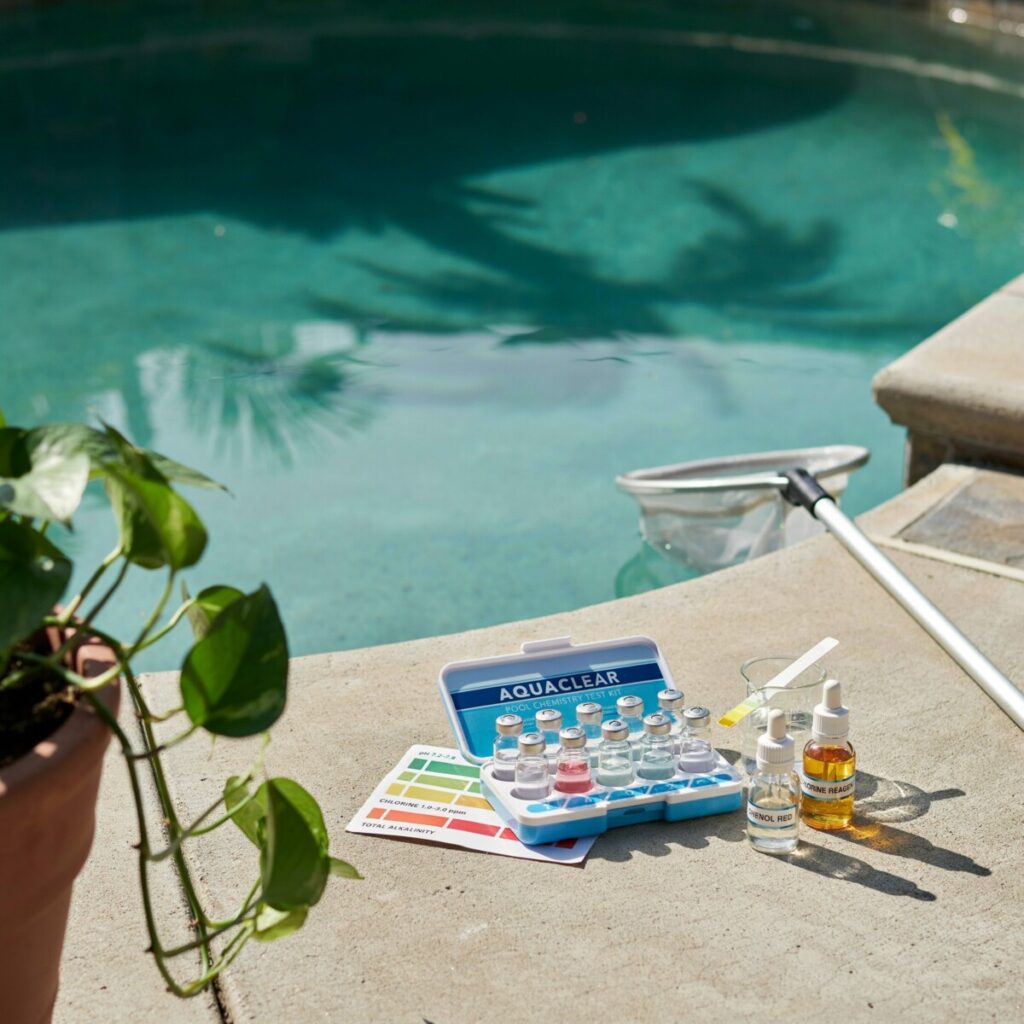
Knowing how to test pool water accurately is just as important as knowing what to test. There are three main categories of testing tools:
- Test Strips: These are cheap, fast, and incredibly easy to use. You simply dip the strip and match the colors to a chart. However, they can be prone to user error and color-fading over time. They are great for quick daily checks.
- Liquid Drop Kits (Titration): The best pool test kit for beginners who want accuracy is a liquid drop kit (like an FAS-DPD kit). You add a reagent powder or liquid drops to a water sample until the color changes. They are highly accurate and essential for measuring exact chlorine levels to shock the pool.
- Digital Testers: These provide digital readouts, removing the guesswork of color-matching. While highly accurate, they require regular calibration and battery replacements, making them a pricier investment.
Pro-Tip for Beginners: Use affordable 4-way or 5-way test strips for your quick daily checks, but keep a high-quality liquid drop titration kit on hand for your weekly deep-dives and troubleshooting.
Tips for Accurate Testing:
- Draw your water sample from elbow depth, about 18 inches away from the pool wall.
- Avoid testing right next to return jets or skimmers, as the water there is not representative of the whole pool.
- Never test immediately after adding chemicals; wait at least 4 to 6 hours for the water to circulate.
- Follow the kit’s timing instructions exactly, and record your results in a logbook to track trends.
Routine Maintenance Schedule
Establishing a consistent swimming pool maintenance schedule prevents 90% of common pool problems. Here is a breakdown of what you need to do to keep your water pristine.
Daily Checklist
- Skim the surface: Remove leaves, bugs, and debris before they sink and decompose.
- Run the filter: Ensure proper pool pump runtime. Most residential pools need the pump to run
8to12hours a day to turn over the water completely. Energy tip: Run your pump during off-peak electricity hours (usually late at night) to save on utility bills. - Test the basics: Check your free chlorine and pH with a quick test strip.
Weekly Checklist
- Comprehensive testing: Use your liquid drop kit to test pH, TA, CYA, and exact free/combined chlorine levels.
- Brush and vacuum: Brush the pool walls to dislodge early algae spores and vacuum the floor.
- Filter care: Check your filter pressure gauge. If it reads
8to10psi above the clean starting pressure, it is time for filter backwash and maintenance (for sand/DE filters) or a cartridge rinse. - Shock if needed: Learn how to shock a pool to destroy combined chlorine and organic waste.
- Monday: Skim, brush walls, check pump basket. Test FC and pH.
- Tuesday: Skim, empty skimmer baskets. Adjust pH if needed.
- Wednesday: Mid-week FC and pH check. Add chlorine if low.
- Thursday: Skim, vacuum the pool floor.
- Friday: Pre-weekend prep. Check filter pressure; backwash if high.
- Saturday: Heavy use day. Ensure FC is at the higher end of the ideal range (3 ppm).
- Sunday: Post-weekend recovery. Test all parameters (pH, TA, CYA, FC, CC). Shock the pool in the evening if combined chlorine is above 0.5 ppm.
Monthly and Seasonal Tasks
- Check Calcium Hardness: Test and adjust pool calcium hardness levels to protect your pool surface.
- Inspect Equipment: Check the pump, heater, and filter for leaks, strange noises, or worn O-rings.
- Deep Clean: Chemically clean your filter cartridges or DE grids.
- Manage CYA: If your cyanuric acid creeps above
80ppm, drain a portion of the pool and refill with fresh water to dilute it.
Common Problems and Troubleshooting
Even with a great routine, issues can arise. Here is how to handle the most common pool chemistry hiccups.
Cloudy Water
A cloudy pool water fix requires a process of elimination. Cloudiness is usually caused by poor filtration, early-stage algae, or imbalanced chemistry (specifically high pH or high calcium).
- Test and Balance: Ensure your pH, TA, and chlorine are perfectly balanced.
- Clean the Filter: Backwash or clean your filter media. A dirty filter cannot catch microscopic particles.
- Shock the Pool: Add a heavy dose of chlorine to kill any suspended bacteria or algae.
- Use a Clarifier: If the water is still hazy after 24 hours of continuous filtration, add a pool clarifier to clump tiny particles together so the filter can catch them. For severe cases, a pool flocculant will sink the debris to the floor for vacuuming. These are excellent pool water clarity solutions.
Algae Blooms
Pool algae treatment and prevention depends on the type of algae:
- Green Algae: The most common. It floats in the water and coats walls. Fix it by brushing the pool thoroughly, balancing the pH, and heavily shocking the pool with liquid chlorine.
- Mustard (Yellow) Algae: Often mistaken for dirt or pollen. It is chlorine-resistant. You will need to brush aggressively and use a specialized mustard algaecide alongside a chlorine shock.
- Black Algae: Forms dark, raised spots with a protective head. It requires intense scrubbing with a stainless-steel wire brush (for plaster pools only) to break the head, followed by targeted algaecide and shock.
Understanding pool shock vs chlorine is vital here. Standard chlorination maintains the pool, while “shocking” means raising the chlorine to a high enough level to rapidly destroy contaminants and algae.
If your pool smells strongly of chlorine and swimmers’ eyes are burning, you likely do not have too much chlorine; you have too much combined chlorine (chloramines). To fix this, you must achieve breakpoint chlorination.
This requires raising the free chlorine level to 10 times the amount of combined chlorine. For example, if your test shows 0.8 ppm of combined chlorine, you need to add enough shock to raise your free chlorine by 8 ppm (0.8×10=8). Once the breakpoint is reached, the chloramines are oxidized and burned off, eliminating the smell and restoring water clarity.
Low or High pH
- Low pH (Acidic): Raise it by adding soda ash (sodium carbonate) or an alkaline increaser.
- High pH (Basic): Lower it by carefully adding muriatic acid or sodium bisulfate (dry acid). Always add acid to water, never water to acid, and re-test after 6 hours of circulation.
Staining and Scaling
Brown or black stains on the pool floor often indicate dissolved metals (like iron or copper) in the water. Treat this by adding a metal sequestrant, which binds to the metals and prevents them from staining the surface. White, crusty scale along the waterline is caused by high calcium hardness and high pH. Lowering the pH and using a scale inhibitor will mitigate this.
When Test Results Bounce
If your test results seem erratic or physically impossible (e.g., pH reads 6.0 one day and 8.4 the next without chemical additions), check your testing method. Reagents expire, and test strips degrade in humidity. Always confirm bizarre results with a second, fresh test kit before adding heavy doses of chemicals.
Safety, Storage, and Disposal
Handling pool chemicals requires respect and caution. Following pool chemical safety tips protects you, your family, and your property.
- Safe Handling: Always wear rubber gloves and safety goggles when handling chemicals. Never mix different chemicals together, as this can cause toxic gas releases or explosions. Always add chemicals to the pool water; never add water to a bucket of dry chemicals.
- Pool Chemical Storage: Store all chemicals in a cool, dry, well-ventilated area, securely locked away from children and pets. Keep liquid acids completely separated from dry chlorine products.
- Transport and Disposal: Transport chemicals in the trunk or bed of your vehicle, never in the passenger cabin. Do not dump large amounts of unused pool chemicals into household trash or storm drains. Follow local regulations for disposal. If you need to drain your pool, you may need to neutralize high-chlorine water with a dechlorinating agent before discharging it, as required by local municipal codes.
For authoritative guidance, US readers should consult the CDC’s Healthy Swimming guidelines and their local county health department for specific legal and safety codes regarding residential pool discharge and chemical handling.
Closing Summary
Mastering swimming pool chemistry doesn’t happen overnight, but it quickly becomes second nature. By maintaining a simple daily and weekly routine, testing your water regularly, and treating minor imbalances before they become major problems, you will enjoy crystal-clear, safe water all season long. Remember: consistency is the secret ingredient to a perfect pool.