You’ve been adding chlorine regularly, shocking the pool on schedule, and still — the water looks cloudy, algae keeps creeping back along the tile line, and your test kit shows free chlorine numbers that just won’t climb. Sound familiar? Before you dump in another bucket of shock, there’s a hidden culprit you need to check: cyanuric acid, also known as pool stabilizer.
Cyanuric acid (CYA) is one of the most misunderstood chemicals in residential pool care. At the right level, it’s a miracle worker that keeps your chlorine from burning off in the afternoon sun. But when CYA levels creep too high — and they almost always do over time — it actually blocks chlorine from doing its job, creating a vicious cycle of algae, cloudiness, and wasted chemicals.
In this guide, you’ll learn exactly what cyanuric acid does, how to test for it properly, the only proven methods to lower CYA safely, and the maintenance habits that prevent it from building back up. Whether you’re a weekend DIY pool owner or managing a small community pool, this step-by-step walkthrough will get your water chemistry back under control.
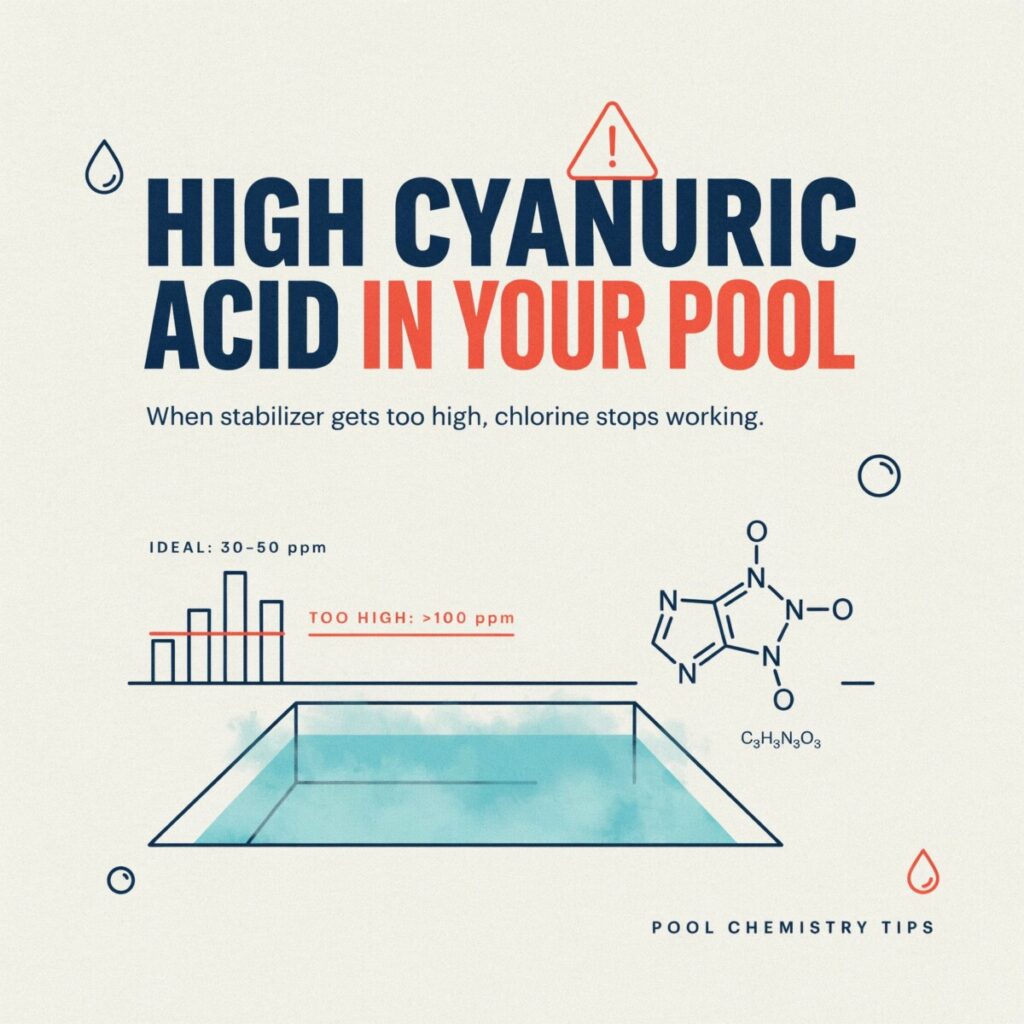
Why Cyanuric Acid Matters
Cyanuric acid is a chemical compound that acts as a chlorine stabilizer. Its job is straightforward: it bonds with free chlorine molecules and shields them from ultraviolet (UV) radiation. Without CYA, sunlight can destroy up to 90% of your pool’s unprotected chlorine in just a few hours on a bright summer day. With the right amount of stabilizer, chlorine lasts significantly longer, saving you money and keeping sanitation steady between doses.
For most outdoor residential pools, the recommended CYA range is 30–50 ppm (parts per million). Saltwater pools with chlorine generators typically perform best at the lower end of that range, around 30–50 ppm, because the generator produces chlorine continuously. Indoor pools, which don’t face UV exposure, generally need little to no CYA — often below 10 ppm.
So how does CYA get too high in the first place? The answer is almost always stabilized chlorine products. Trichloroisocyanuric acid (trichlor) tablets and pucks — the slow-dissolving tabs that sit in your skimmer or inline feeder — add both chlorine and cyanuric acid every time they dissolve. Dichlor-based pool shock does the same thing. Even some algaecides and “all-in-one” maintenance products contain stabilized chlorine. Over a single swim season, a pool treated exclusively with trichlor tablets can easily see CYA climb past 100 ppm without the owner realizing it.
Signs You Have High CYA
Quick Symptom Checklist
- Chlorine readings drop to near-zero within hours of adding shock
- Persistent green or mustard algae despite regular treatment
- Cloudy, dull water that won’t clear after filtration
- You’re using significantly more chlorine than you did last season
- Saltwater chlorine generator runs at 100% but can’t maintain sanitizer levels
High cyanuric acid doesn’t announce itself with a dramatic event. Instead, it creates a slow, frustrating deterioration in your pool water chemistry that most owners misdiagnose as a pump problem, a filter issue, or “just a bad summer.”
The core problem is that CYA locks up chlorine. Research has shown that for every 10 ppm increase in CYA, the minimum effective level of free chlorine needed to kill bacteria and algae rises proportionally. At 30 ppm CYA, you might only need 2–3 ppm of free chlorine. At 100 ppm CYA? You’d need 8–10 ppm just to maintain basic sanitation — and well over 20 ppm to actually shock the pool effectively. Most homeowners never reach those levels, so their chlorine is essentially powerless.
The operational consequences compound quickly:
- Algae blooms become more frequent and harder to eliminate, requiring repeated (and increasingly ineffective) shock treatments.
- Chemical costs spiral as you buy more chlorine, more algaecide, and more clarifier chasing a problem that chemistry alone can’t fix.
- Filtration systems strain under the load of dead algae and suspended particles, shortening pump and filter life.
- Saltwater chlorine generators overwork and degrade faster because they can never produce enough chlorine to overcome the CYA barrier.
If any of these cyanuric acid problems sound like your pool, it’s time to test.
How to Test Your Pool’s CYA
Accurate testing is the foundation of fixing high stabilizer levels. There are several options, and they vary widely in reliability.
Drop-Based Test Kits (Recommended)
A quality drop test kit — such as the Taylor K-2006 or the TF-100 — is the gold standard for residential testing. These kits use a turbidity test: you add a reagent to a water sample, and the solution turns cloudy as it reacts with CYA. You then compare the cloudiness against a marked tube to read the ppm level. They’re reliable, reusable, and accurate to within about ±10 ppm.
Test Strips
Test strips are convenient but notoriously inaccurate for CYA readings. The color-matching pads can be difficult to read, and results often vary by 20–30 ppm from actual values. Use strips for quick daily checks of chlorine and pH, but rely on a drop kit or professional test for cyanuric acid test results.
Pool Store and Lab Testing
Most pool supply stores offer free water testing using commercial-grade photometers, which are highly accurate. This is a great option if you don’t own a drop kit. Some municipalities or pool service companies also offer mail-in lab analysis.
Testing Best Practices
- Pull the sample from 18 inches below the surface, away from return jets and skimmers. Surface water is not representative.
- Test CYA at least once a month during swim season, and every 1–3 months in the off-season.
- Always test CYA before adding stabilized chlorine products, especially at the start of the season.
What Counts as “High” CYA?
| Pool Type | Ideal CYA Range | Concern Level | Action Threshold |
|---|---|---|---|
| Outdoor chlorine pool | 30–50 ppm | 50–80 ppm | >80 ppm |
| Saltwater pool | 30–50 ppm | 50–70 ppm | >70 ppm |
| Indoor pool | 0–10 ppm | >20 ppm | >20 ppm |
If your CYA ppm reading is above the action threshold for your pool type, it’s time to take corrective steps.
Safe Ways to Lower Cyanuric Acid
Here’s the hard truth that most pool chemical companies won’t tell you: there is no chemical that removes cyanuric acid from pool water. No powder, liquid, or enzyme will break down or precipitate CYA out of your water. The only proven, reliable methods to lower CYA in pool water involve physically removing the CYA-laden water and replacing it with fresh water.
Partial Drain and Refill
This is the most common and cost-effective method for residential pools. The concept is simple: drain a calculated percentage of your pool water (which contains the high CYA) and refill with fresh municipal or well water (which contains zero CYA).
How to calculate how much to drain:
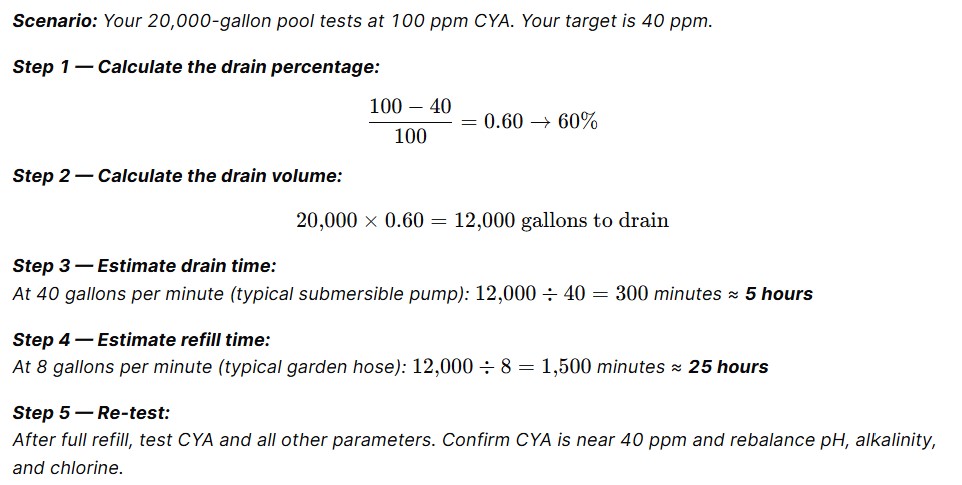
The formula is straightforward. If your current CYA is 100 ppm and your target is 40 ppm, you need to replace roughly 60% of the water. Here’s the logic:

That means draining approximately 12,000 gallons and refilling. See the example calculation box below for a step-by-step walkthrough.
Practical steps for a partial drain:
- Turn off the pump and filter system. Never run equipment while draining.
- Set up a submersible pump with a discharge hose leading to an approved drainage point (storm drain, sanitary sewer access, or yard area that won’t flood neighbors). Check local regulations first.
- Drain slowly — most residential pumps move 30–50 gallons per minute, so a 12,000-gallon drain takes 4–7 hours.
- Never drain below the skimmer or main drain level without supervision — running a pump dry will destroy it.
- Refill with a garden hose, monitoring the fill. A standard outdoor spigot delivers roughly 5–10 gallons per minute, so refilling 12,000 gallons takes 20–40 hours.
- Re-test all chemistry after refill. Fresh water resets your pH, alkalinity, calcium hardness, and chlorine levels — expect to rebalance everything.
💡 Tip: Schedule your drain-and-refill for cool, overcast weather. Draining a pool in direct summer heat risks plaster cracking, vinyl liner shrinkage, and fiberglass shell damage from thermal stress. Never leave a partially drained pool unattended for extended periods — hydrostatic pressure from groundwater can literally pop a pool out of the ground.
Reverse Osmosis Pool Service
If you live in an area with water-use restrictions, or if your pool is too large or delicate for a full partial drain, a reverse osmosis pool service is a premium alternative. An RO service company brings a mobile treatment unit to your property, pumps your pool water through a series of membranes that filter out CYA, dissolved solids, calcium, and other contaminants, and returns clean water to the pool — all without draining.
Pros:
- No water waste — up to 90% of your water is conserved
- Removes total dissolved solids (TDS), calcium, and metals in addition to CYA
- No risk of liner shrinkage, plaster damage, or hydrostatic uplift
- Often completed in a single day
Cons:
- Costs typically range from $1,500–$3,500+ depending on pool size and region
- Not available in all areas — search “reverse osmosis pool service near me” to check availability
- Requires scheduling in advance during peak season
RO makes sense for pools with extremely high CYA (150+ ppm), very large pools where drain-and-refill would take days, or regions with strict water conservation ordinances.
What Not to Do
When searching for how to lower cyanuric acid, you’ll encounter products and “hacks” that promise chemical CYA reduction. Here’s what to avoid:
- “CYA reducer” chemicals: No EPA-registered or independently verified product on the U.S. market chemically removes CYA. Products marketed as CYA reducers are typically enzymes or clarifiers that address organic contaminants, not dissolved stabilizer.
- Bleach or muriatic acid: Adding household bleach or muriatic acid does nothing to reduce CYA levels. These alter pH and chlorine but leave stabilizer untouched.
- Natural bacterial breakdown: Some online forums suggest that certain bacteria can slowly degrade CYA over months or years. While technically true in laboratory conditions, this process is far too slow and unpredictable to be a practical pool care strategy.
The only reliable way to reduce pool stabilizer is water replacement — either by partial drain-and-refill or reverse osmosis filtration.
Restoring Chlorine and Restarting Treatments
Once your CYA is back in the target range, your chlorine will suddenly become dramatically more effective — often within hours. But you need to recalibrate your approach to avoid over-chlorinating.
Shock Strategies
The concept of breakpoint chlorination is key here. Breakpoint chlorination means adding enough chlorine to fully oxidize combined chlorine (chloramines) and organic contaminants, creating a “break point” where free chlorine levels finally rise and stay elevated. With lower CYA, the chlorine dose needed to reach breakpoint is significantly smaller.
As a general rule, your minimum free chlorine level should be roughly 7.5% of your CYA level. So:
- At 40 ppm CYA → maintain at least 3 ppm free chlorine
- At 50 ppm CYA → maintain at least 4 ppm free chlorine
- At 30 ppm CYA → maintain at least 2 ppm free chlorine
After a drain-and-refill, shock the pool with unstabilized chlorine (liquid sodium hypochlorite or calcium hypochlorite) to establish a healthy baseline. Avoid trichlor or dichlor shock products — they’ll start adding CYA right back immediately.
Recalibrating Saltwater Systems
If you have a saltwater chlorine generator, reduce the output percentage after lowering CYA. A system that was running at 80–100% to fight high CYA will likely only need 30–50% output once CYA is in the 30–50 ppm range. Check your manufacturer’s chart for saltwater pool CYA recommendations and adjust accordingly.
Re-Testing Schedule
- Immediately after refill or RO treatment: test all parameters (CYA, pH, alkalinity, calcium hardness, chlorine, salt level).
- 48 hours later: re-test to confirm stability.
- Weekly for one month: monitor CYA, chlorine, and pH.
- Monthly thereafter: regular maintenance testing.
Preventing CYA Buildup Long-Term
The single most effective pool maintenance tip for preventing high CYA is switching from stabilized to unstabilized chlorine for your regular sanitation routine.
Stabilized vs. Unstabilized Chlorine
| Product Type | Stabilized? | Adds CYA? | Best Use |
|---|---|---|---|
| Trichlor tablets/pucks | ✅ Yes | ✅ Yes | Short-term use only, vacation dosing |
| Dichlor shock | ✅ Yes | ✅ Yes | Avoid for routine shock |
| Liquid chlorine (bleach) | ❌ No | ❌ No | Daily/weekly chlorination |
| Calcium hypochlorite (cal-hypo) | ❌ No | ❌ No | Routine shock treatments |
| Salt chlorine generator | ❌ No | ❌ No | Continuous sanitation |
Use liquid chlorine or cal-hypo as your primary chlorine source. Reserve trichlor tablets for situations where you need slow-dissolve convenience — like a week-long vacation when you won’t be home to dose manually. Even then, pull the feeder out when you return.
Pool Shock and CYA — Choose Wisely
A common mistake is using dichlor-based “multi-purpose” shock weekly throughout the summer. Each pound of dichlor adds roughly 0.6 ppm of CYA per 10,000 gallons. Over 20 weeks of weekly shocking, that’s 12+ ppm of CYA added — on top of whatever your tablets contribute. Switch to cal-hypo shock or liquid chlorine shock for routine oxidation.
Maintenance Habits
- Test CYA monthly from May through September and after any heavy chlorination event (algae treatment, storm cleanup, pool party).
- Keep CYA at the lower end of the recommended range (30–40 ppm). It’s much easier to add a small amount of stabilizer if levels drop than to remove it if they climb.
- Run your filter 8–12 hours daily during swim season to maximize circulation and chlorine distribution.
- Brush walls weekly and maintain proper alkalinity and calcium hardness — balanced pool water chemistry reduces the chlorine demand that tempts you to over-shock.
When to Call a Professional
Most residential pool owners can handle a partial drain-and-refill on their own. But there are situations where calling a licensed pool service professional is the smart move:
- CYA above 150 ppm: The drain volume required is enormous, and the refill timeline stretches into multiple days. A pro with RO equipment can handle this in a single visit.
- Vinyl liner or fiberglass pools in areas with high water tables: hydrostatic pressure risk during draining requires professional judgment and possibly well-point dewatering equipment.
- Repeated CYA recurrence despite correct maintenance: a pro can audit your chemical program, check for hidden sources of stabilized chlorine, and recommend system upgrades.
- Commercial pools, HOA pools, or community pools: local health codes often require certified operators to supervise drain-and-refill events and document chemical adjustments.
A professional service visit typically includes comprehensive water testing, a controlled partial drain or RO treatment, full chemical rebalancing, and recalibration of automated feeders and chlorine generators.
The Bottom Line
High cyanuric acid is one of the most common — and most fixable — problems in residential pool care. It doesn’t mean your pool is broken or that you need to invest in expensive new equipment. It simply means your water has accumulated too much stabilizer over time, and you need to dilute it back down.
Test your CYA today. If it’s above your target range, plan a partial drain-and-refill or look into reverse osmosis service in your area. Switch to unstabilized chlorine for your daily and weekly routines. Within a week, you’ll see the difference: clearer water, lower chemical bills, and a chlorine reading that actually holds steady.
Your pool will thank you.
Frequently Asked Questions
Can I lower CYA with chemicals?
No. There is currently no chemical product — including enzymes, clarifiers, or specialty “CYA reducers” — that removes cyanuric acid from pool water in any practical timeframe. The only reliable methods to lower CYA are partial drain-and-refill (replacing CYA-rich water with fresh water) or reverse osmosis filtration. Any product claiming to chemically reduce CYA should be viewed with skepticism.
What is a safe CYA level for my pool?
For most outdoor residential chlorine pools, a safe and effective CYA ppm range is 30–50 ppm. Saltwater pools with chlorine generators also perform well in the 30–50 ppm range. Indoor pools should stay below 10–20 ppm since UV exposure is not a factor. Levels above 80 ppm consistently cause reduced chlorine effectiveness and should be addressed.
How often should I test cyanuric acid?
Test CYA at least once a month during swim season (roughly May through September in most U.S. climates) and every 1–3 months during the off-season. Always test after opening the pool in spring, after heavy rain or significant water replacement, and before adding any stabilized chlorine product. A quick monthly drop test takes less than five minutes and can prevent an entire season of chemical frustration.
📐 Example Calculation: How Much Water to Drain
💡 For exact calculations based on your pool’s dimensions and current chemistry, use an online pool water calculator or consult your local pool professional.