
If you own a pool in the US, you’ve probably stared at a cloudy, greenish, or oddly smelly backyard oasis and wondered what went wrong. More often than not, the culprit isn’t a broken pump or a bad filter — it’s water chemistry. Cloudiness, scaling on tile, corroded ladders, stinging eyes, and fading chlorine levels almost always trace back to two numbers on your test kit: pH and total alkalinity.
Plenty of pool owners use the terms interchangeably, and that’s where problems start. Adding baking soda won’t fix a pH spike, and dumping in muriatic acid won’t always bring alkalinity back in line. The fix begins with understanding that pool alkalinity vs pH is not a single measurement — it’s two linked but distinct parts of your water’s balance system.
This guide will break down exactly what pH and total alkalinity (TA) do, how they influence each other, and the step-by-step way to test pool pH, adjust both values safely, and maintain pool water so it stays clear, comfortable, and equipment-friendly all season.
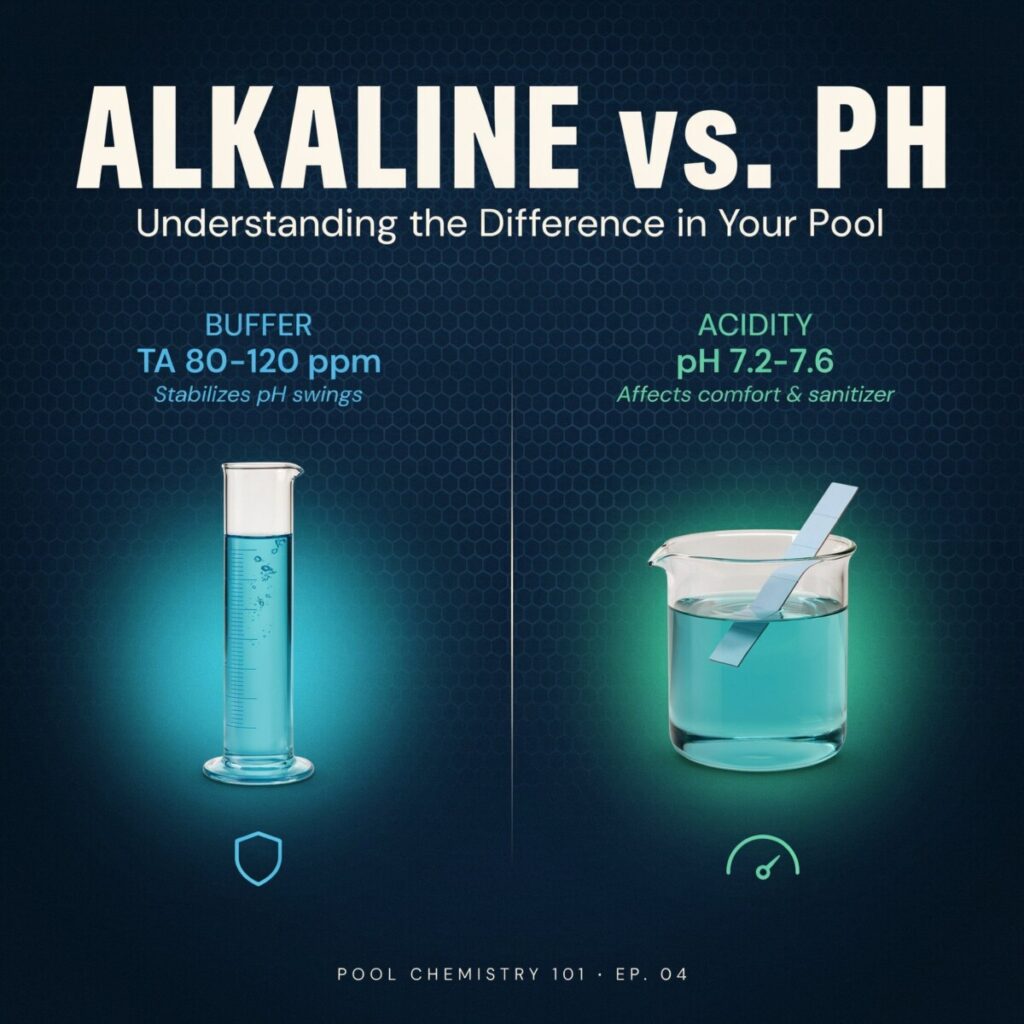
What Is pH?
At its simplest, pH measures how acidic or basic (alkaline) your pool water is right now. The pH scale runs from 0 to 14. A reading of 7.0 is neutral. Anything below 7.0 is acidic; anything above 7.0 is basic.
For US residential pools, the accepted ideal range sits between 7.2 and 7.8, with most pros targeting around 7.4–7.6. That sweet spot mirrors the pH of human eyes and mucous membranes, which is why a properly balanced pool feels comfortable on your skin.
Why does the number matter so much?
- Swimmer comfort. Water below 7.2 stings eyes and dries skin. Water above 7.8 feels slick and can irritate just as badly.
- Chlorine effectiveness pH depends on. At pH 8.0 and above, chlorine’s killing power drops dramatically — you can have high sanitizer readings but still get algae.
- Equipment protection. Low pH eats metal heaters, ladder bolts, and pump seals. High pH scales surfaces and clogs filters.
Think of pH like a thermostat for acidity. Just as a thermostat tells you the current temperature of a room, pH tells you the current “acidity temperature” of your water. But just as a thermostat doesn’t tell you how well the house holds heat, pH alone doesn’t tell you how stable that number will be over the next few days. For that, you need the next player: alkalinity.
What Is Total Alkalinity (TA)?
Total alkalinity (TA) measures how well your pool water resists changes in pH. Where pH is a snapshot, TA is the buffer — the water’s built-in shock absorber that keeps pH from swinging wildly whenever rain falls, chlorine is added, or swimmers jump in.
TA is measured in parts per million (ppm), not on the 0–14 scale. For most US pools, the ideal range is 80–120 ppm. Pools in hard-water regions like the Southwest or parts of the Midwest often sit closer to 120–140 ppm naturally, while soft-water areas in the Northeast or Pacific Northwest may require more active alkalinity management.
Here’s the key distinction: a pool with perfect pH but low TA is a ticking time bomb. Today’s reading may be 7.4, but tomorrow, after a thunderstorm or a busy pool party, it could drop to 6.8 or spike to 8.2. That whiplash is what pool pros call pH bounce, and it’s one of the most frustrating issues homeowners face when trying to how to balance pool water.
TA matters because it:
- Stabilizes pH so small chemical additions don’t cause big swings.
- Protects plaster, pebble, and vinyl surfaces from etching or scaling.
- Shields metal components — heaters, rails, light rings — from corrosive attack.
- Supports chlorine performance indirectly by keeping pH in the zone where sanitizer works best.
Use this analogy: if pH is the car’s speed, alkalinity is the shock absorber. On a road full of bumps (rain, bather load, chlorine tabs, fill water), a good shock absorber keeps the ride smooth. Too little cushion and the car bounces off the road; too much and the suspension feels rigid and won’t respond when you need it to.
How pH and Alkalinity Interact
Chemically, TA is mostly made up of bicarbonate, carbonate, and hydroxide ions floating in your water. These ions absorb hydrogen ions (which lower pH) or release them (which raise pH), smoothing out chemical shocks.
When TA is too low (below 60 ppm), your pool has almost no buffering capacity. The result:
- pH bounces wildly from day to day.
- Plaster and grout can etch, leaving rough surfaces.
- Heater cores and ladder brackets corrode faster.
- Swimmers complain of red eyes even when pH “looks fine” during the test.
When TA is too high (above 160 ppm), the buffer becomes so strong that pH resists adjustment. You can add acid and the number barely moves, or it creeps upward on its own as dissolved CO₂ off-gasses. High TA combined with high pH and hard water is a recipe for:
- Cloudy water that won’t clear with clarifier.
- White scale on tile lines and salt cells.
- Reduced chlorine effectiveness and occasional “chlorine lock” symptoms.
A Real-World Example
Imagine a 20,000-gallon pool in Houston after three days of heavy summer rain. The rain dilutes the water and introduces slightly acidic runoff. By Monday, pH has dropped from 7.4 to 6.9, and the water looks dull. If TA was a healthy 100 ppm, the drop would have been minor — maybe 7.4 to 7.2. If TA had slipped down to 50 ppm over the season, that same rain could hammer pH into the low 6s, etching plaster and stinging every swimmer.
This is why experienced pool techs always check both numbers. Knowing how pH and alkalinity interact lets you predict what will happen after a storm, a big party, or a refill — and treat proactively instead of chasing symptoms.
How to Test Your Pool
You can’t fix what you don’t measure. The good news: accurate testing is cheap and takes under two minutes. Here are the main methods US pool owners use.
- Test strips. Fast, affordable, and great for quick weekly checks. Less precise than other methods, especially for alkalinity, but modern premium strips (AquaChek, LaMotte) get you within ~10 ppm.
- Liquid drop kits (DPD / titration). The gold standard for DIYers. A Taylor K-2006 or similar kit gives lab-grade readings for pH, TA, chlorine, and calcium hardness. Requires a few drops and counting color changes.
- Digital pH meters. Highly accurate for pH, but they don’t read TA, must be calibrated regularly, and cost $40–$150+. Best paired with a drop kit for alkalinity.
How often to test:
- Weekly during swimming season, ideally on the same day.
- After heavy rain, big parties, or chemical additions.
- Before opening for the season and before winterizing.
Best practices: sample at elbow depth in the middle of the pool, never near a skimmer, return jet, or chlorine feeder. Let the pump run for at least an hour before testing. Rinse the vial with pool water first, follow the kit’s timing exactly, and read results in natural daylight whenever possible.
How to Adjust pH and Alkalinity
Once you know your numbers, the adjustment sequence matters. The general rule is alkalinity first, pH second. TA is the buffer — set it correctly and pH corrections will hold. Try to fix pH with an out-of-range TA and you’ll be back at the test kit in two days.
Raising Alkalinity
The safest and most common way to raise alkalinity in pool water is with baking soda for pool alkalinity — plain sodium bicarbonate, sold in bulk as “Alkalinity Up” at pool stores. Rule of thumb: 1.5 lb of baking soda per 10,000 gallons raises TA by about 10 ppm. Broadcast it across the deep end with the pump running, wait 6 hours, and retest.
Lowering Alkalinity
Lowering TA is slower and trickier. You use muriatic acid for pool use (31.45% hydrochloric acid) or dry sodium bisulfate (“pH Minus”). Because acid also lowers pH, the trick is to add small doses, let pH drop, then aerate the water (point returns upward, run a fountain, or use a spa blower) to off-gas CO₂ and lift pH back up without raising TA. Repeat as needed. Never try to drop TA more than 20 ppm in a single day.
Raising pH
For a quick pH bump without moving TA much, use soda ash pool pH treatment — sodium carbonate, sold as “pH Up.” About 6 oz per 10,000 gallons raises pH roughly 0.2 units. Add it slowly near a return with the pump on high. Avoid dumping it straight into the skimmer.
Lowering pH
The workhorse is again muriatic acid for pool use or sodium bisulfate. For a 10,000-gallon pool, roughly 1 cup (~8 oz) of diluted muriatic acid will drop pH by about 0.2 units. Always wear gloves, eye protection, and long sleeves. Add acid to water, never water to acid. Pour slowly into the deep end with the pump running, then wait at least 4 hours before retesting.
📊 Quick Dosage Reference (click to expand)
| Goal | Product | Approx. dose per 10,000 gal | Expected change |
|---|---|---|---|
| Raise TA | Baking soda (sodium bicarbonate) | 1.5 lb | +10 ppm TA |
| Lower TA | Muriatic acid + aeration | 1 cup acid, then aerate | −10 to 20 ppm TA per cycle |
| Raise pH | Soda ash (sodium carbonate) | 6 oz | +0.2 pH |
| Lower pH | Muriatic acid (31.45%) | 8 oz (1 cup) | −0.2 pH |
| Lower pH (gentler) | Sodium bisulfate (dry acid) | 12 oz | −0.2 pH |
Always follow the product label — results vary with pool volume, starting chemistry, and water temperature. Add in stages, retest after 4–24 hours, and keep a logbook.
Sequencing summary: fix TA first → retest → adjust pH → retest → confirm chlorine is in range. Never dump huge doses at once; overcorrection leads to the see-saw cycle that damages surfaces and burns through chemicals.
Practical Pool Maintenance Tips and Best Practices
Keeping your water balanced long-term is mostly about routine. Build these habits and you’ll spend less time troubleshooting and more time swimming.
- Test pH and TA weekly in season, alongside free chlorine and cyanuric acid.
- Log your readings in a notebook or app — patterns reveal issues before they become problems.
- Inspect equipment monthly for scale on salt cells, corrosion on heater fittings, and etching on plaster.
- Balance before shocking. High pH makes shock treatments far less effective.
- After heavy rain, dilution often lowers TA — test and top off with baking soda as needed.
- At spring startup, expect to rebalance everything; fill water is rarely neutral.
- Before winterizing, bring TA to ~100 ppm and pH to 7.4–7.6 to protect surfaces over the off-season.
When to call a pro: persistent cloudiness after two rounds of correction, recurring algae despite proper chlorine, visible plaster damage, heater leaks, or any time you need to drain and refill more than a third of the pool. A certified pool operator can run a full panel — including metals and phosphates — that a home kit can’t.
Conclusion
The phrase “alkaline vs. pH” really describes a partnership. pH tells you where your water’s acidity sits right now. Total alkalinity tells you how stubbornly it will stay there. Get both in range — pH between 7.2 and 7.8, TA between 80 and 120 ppm — and your water stays clear, swimmers stay comfortable, chlorine stays effective, and your equipment lasts for years instead of months.
This week, grab your pool water testing kit, take a fresh sample from mid-depth, and look at both numbers side by side. If you’ve only been watching pH, alkalinity is probably the missing piece. For a quick cheat sheet you can stick on the pump equipment pad, [download our printable pool chemistry chart here], or reach out to a local pool service for a free water analysis.
❓ Frequently Asked Questions
1. Can I use household vinegar to adjust my pool’s pH?
You can in a pinch, but it’s not ideal. Vinegar is weak (about 5% acetic acid), breaks down quickly, and introduces organic carbon that can feed bacteria. Muriatic acid or sodium bisulfate at the correct dose is cheaper, faster, and cleaner.
2. Why does my pH keep rising even after I add acid?
This usually means high TA. The water has so much buffering capacity that carbon dioxide off-gasses into the air and pH climbs back up. Lower TA gradually with acid plus aeration, and the drift will slow.
3. Is “alkaline water” the same as high-alkalinity pool water?
No. Bottled “alkaline water” typically has a high pH (8–9.5) with modest mineral content. Pool alkalinity refers to the concentration of bicarbonate and carbonate ions, measured in ppm. A pool can have neutral pH but high TA, or basic pH but low TA — which is why you measure both separately.