
When you think of a saltwater pool, you probably picture crystal-clear water, softer skin, and no harsh chemical smell. It’s easy to see why they’ve become the gold standard for backyard retreats across the United States. But as a homeowner considering the switch—or one who has already made the leap—you might be wondering: Will saltwater corrode my pool deck or equipment?
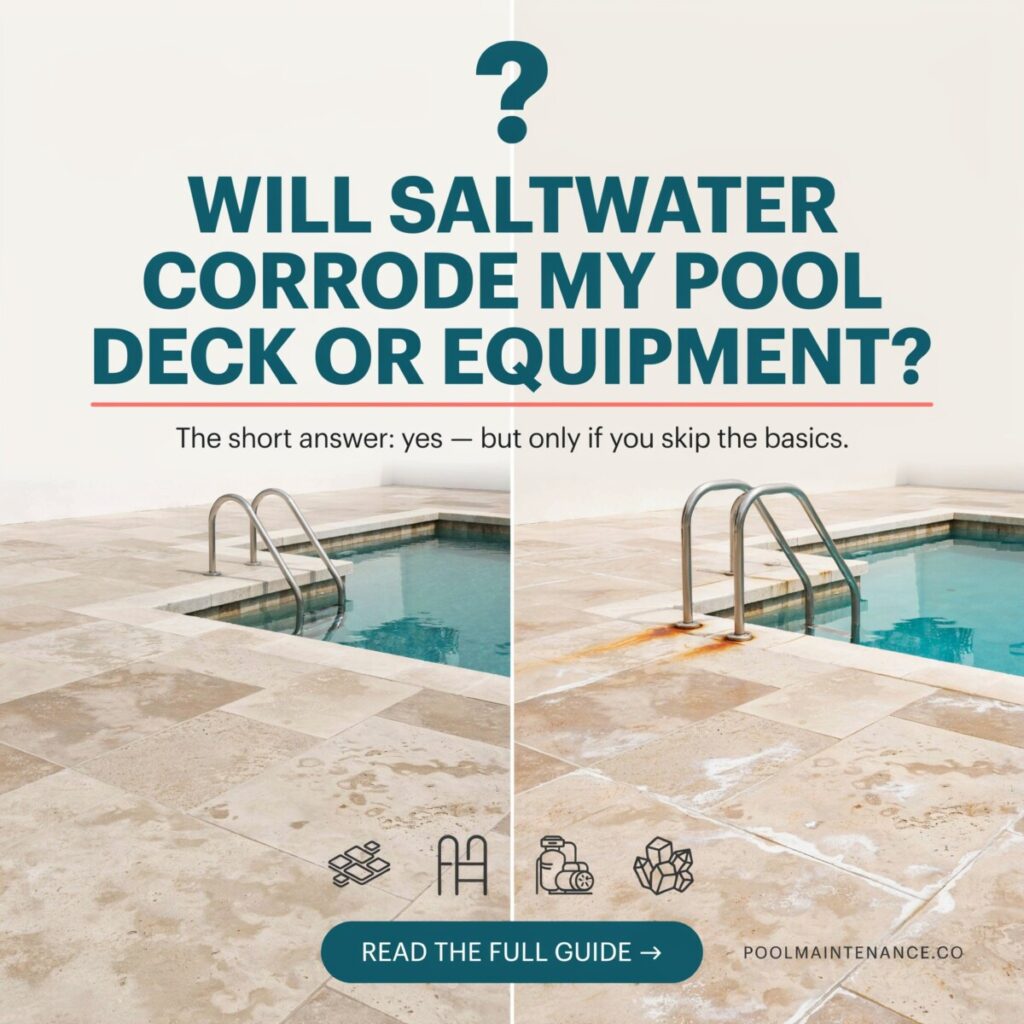
The short answer is yes, saltwater can corrode your pool deck and equipment if left unchecked. However, the idea that saltwater pools rapidly destroy everything they touch is one of the most persistent saltwater pool myths. In reality, the salinity level of a saltwater pool is roughly one-tenth that of the ocean. While it’s not enough to make your backyard feel like the beach, dissolved salt is still present, and splash-out can accumulate on surrounding surfaces over time.
Fortunately, saltwater pool corrosion is highly manageable. With the right saltwater pool deck materials, proper equipment choices, and a proactive maintenance routine, you can enjoy all the benefits of a saltwater system without constantly worrying about rust and decay. In this comprehensive guide, we’ll break down exactly how saltwater affects your pool environment, which areas are most at risk, and the practical steps you can take to protect your investment.
How Saltwater Pools Work: The Chemistry Behind the Clean
To understand the risks, it helps to understand the chemistry. Many people assume that a saltwater pool is just a giant tub of seawater, but that’s far from the truth. A traditional chlorine pool relies on manually added chemical chlorine (tablets, liquid, or granules) to sanitize the water. A saltwater pool, on the other hand, generates its own chlorine on-site.
This magic happens inside a device called a Salt Chlorine Generator (SWG), or salt cell. As the pool water passes through the cell, it undergoes a process called electrolysis. The system uses electricity to separate the sodium and chloride molecules in the dissolved salt, creating hypochlorous acid—the exact same active sanitizing agent found in traditional chlorine pools.
Because the chlorine is generated continuously, the water often feels silkier, smells less like chemicals, and is gentler on the eyes and skin. The salt concentration in these pools typically ranges from 2,700 to 3,400 parts per million (ppm). For comparison, human tears are about 7,000 ppm, and the ocean is a whopping 35,000 ppm.
So, while the water inside the pool isn’t incredibly salty, the salt never leaves the system unless the water is drained or splashed out. When water evaporates off your deck, the salt is left behind as a solid crystal. Over months and years, this continuous cycle of splashing, evaporating, and crystallizing is what ultimately leads to saltwater pool deck damage and potential issues with your saltwater pool equipment. Understanding this cycle is the first step toward effective saltwater pool maintenance.
Can Saltwater Corrode a Pool Deck?
Your pool deck takes a beating from the sun, foot traffic, and constant exposure to chemically treated water. When you add salt to the equation, the dynamics change slightly. Pool deck corrosion and surface degradation are real concerns, but they usually stem from how the water interacts with the deck material rather than the pool water itself.
The Role of Porosity and Sealing
The vulnerability of your deck largely depends on what it’s made of. Highly porous materials—such as unsealed concrete, certain types of natural stone (like unsealed travertine, bluestone, or flagstone), and untreated pavers—absorb splashed pool water. As the water evaporates, the salt is drawn deep into the pores. When salt crystals form and expand inside the microscopic holes of the stone or concrete, they create immense internal pressure. Over time, this leads to a process called spalling, where the top layer of the stone flakes, chips, or pops off. You may also notice a white, powdery residue known as efflorescence, which is the salt being pushed to the surface.
Drainage and Splash Zones
Poor drainage exacerbates saltwater pool deck damage. If your deck slopes toward the pool or has low spots where puddles form, the standing water will continuously deposit salt onto the surface as it evaporates. High-traffic splash zones—like the areas directly beneath diving boards, slides, or pool steps—will see the most rapid accumulation of salt crystals.
Concrete and Coping
Poured concrete and stamped concrete are generally more resistant to salt damage than natural stone, provided they were sealed properly during installation and resealed regularly. The coping—the capstone or edge material that sits directly on the pool beam—is in the direct line of fire for splash-out. If you have limestone coping, you are at a much higher risk for rapid deterioration, as limestone is highly reactive to both salt and the slightly acidic nature of pool water.
Choosing the best pool deck materials for saltwater pools from the start, such as high-quality porcelain pavers, sealed composite decking, or dense, properly sealed natural stone, can dramatically reduce your risk of long-term deck damage.
Can Saltwater Damage Pool Equipment?
A common question among new pool owners is: does salt water damage pool equipment? The honest answer is that it can, but modern pool equipment is generally built to handle the environment if installed and maintained correctly. The real threats come from splash-out, salt air and pool damage in coastal environments, and a phenomenon known as galvanic corrosion.
Galvanic Corrosion Explained
Galvanic corrosion occurs when two dissimilar metals are submerged in an electrolyte—in this case, saltwater. The saltwater conducts a low-voltage electrical current between the metals. The more “active” (anodic) metal will corrode rapidly to protect the more “noble” (cathodic) metal. For example, if you have a standard steel ladder bolted to an aluminum pool light niche, the steel ladder will rust away at an accelerated rate. This is why proper electrical bonding of the pool shell and all metal components is not just a code requirement; it’s a critical defense against galvanic corrosion.
Ladders and Handrails
Pool handrails corrosion and ladder degradation are among the most visible signs of salt-related damage. Standard powder-coated or galvanized steel rails can rust quickly if the coating gets scratched and saltwater penetrates the surface. Even lower-grade stainless steel can pit and rust in a saltwater environment.
Heaters and Pumps
Pool heater corrosion is a significant concern, particularly in the heat exchanger. Many older or budget-friendly heaters use standard copper heat exchangers, which can degrade over time when exposed to the high-salinity water passing through them. However, many modern heaters designed for saltwater pools feature specialized titanium or highly resistant cupro-nickel heat exchangers that withstand the electrolysis process without issue. Similarly, pool pump corrosion is rare in modern, high-quality pumps because the wet-end components are usually made of high-impact, corrosion-resistant plastics and polymers that do not react with salt.
Light Fixtures and Fasteners
Pool lights and underwater fasteners are constantly submerged, making them prime candidates for rust on pool equipment if the wrong materials are used. Stainless steel screws used to mount underwater light bezels can rust and streak the pool plaster if they are not marine-grade.
Ultimately, protecting your saltwater pool equipment isn’t about avoiding salt altogether; it’s about selecting the right materials and ensuring your pool’s electrical bonding is up to code.
What Materials Hold Up Best Against Saltwater?
If you are building a new pool, renovating an existing one, or replacing worn-out components, choosing corrosion resistant pool fixtures and materials is the best defense against degradation. Here is a breakdown of the materials that hold up best in a saltwater environment.
Stainless Steel Grades
Not all stainless steel is created equal. For a saltwater pool, you should exclusively use marine-grade 316 stainless steel for handrails, ladders, diving board stands, and underwater fasteners. Grade 316 contains molybdenum, an alloy that significantly boosts its resistance to chlorides and salt. Grade 304 stainless steel is acceptable for above-deck furniture or fixtures that only occasionally get splashed, but it will eventually pit and rust if constantly submerged. Avoid anything labeled simply as “stainless steel” without a grade specification, as it is likely a lower-grade 400-series steel that will rust rapidly.
Coated Metals and Polymers
Many modern saltwater pool equipment manufacturers use advanced polymer coatings on metal parts. Polymer-coated aluminum or steel ladders are incredibly popular because the thick plastic barrier completely isolates the metal from the saltwater. Additionally, structural components made from high-density polyethylene (HDPE) or reinforced polymers are completely immune to salt corrosion.
Decking and Coping Materials
When considering the best pool deck materials for saltwater pools, look for non-porous or easily sealable options:
- Porcelain Pavers: Highly dense, virtually non-porous, and completely unaffected by salt.
- Sealed Travertine: A popular choice for its cool surface temperature, but it must be sealed with a high-quality, salt-resistant penetrating sealer every 1–2 years.
- Composite Decking: Made from a blend of wood fibers and plastics, composite decking is highly resistant to salt, rot, and splintering.
- Exposed Aggregate Concrete: When properly sealed, it provides excellent slip resistance and holds up well against salt accumulation.
Proper Bonding
We cannot overstate the importance of electrical bonding. A copper wire should connect the pool water, the steel reinforcement in the concrete shell, the coping, the equipment, and all metal rails within three feet of the pool. This creates a continuous loop that prevents electrical currents from traveling through the water and causing galvanic corrosion. Always hire a licensed professional to verify your pool’s bonding grid.
How to Prevent Corrosion in Your Saltwater Pool
The good news is that saltwater pool corrosion prevention doesn’t require a massive time commitment. By adopting a few saltwater pool maintenance tips for homeowners, you can easily protect your backyard oasis. Here is how to protect pool equipment from salt and keep your deck looking pristine.
1. Maintain Balanced Water Chemistry
Salt is just one component of your pool’s chemistry. If your water is unbalanced—specifically, if the pH is too low (acidic) or the calcium hardness is too low (aggressive)—the water will actively seek out minerals to dissolve, eating away at your plaster, stone coping, and metal fixtures. Keep your pH between 7.4 and 7.6, total alkalinity between 80 and 120 ppm, and calcium hardness between 200 and 400 ppm. Keep your salt levels exactly where the manufacturer recommends (usually around 3,000–3,200 ppm). Adding too much salt won’t make the water cleaner; it will just increase the salinity of the splash-out.
2. Rinse Surfaces Regularly
The simplest way to prevent saltwater pool deck damage is to wash the salt away before it can crystallize and penetrate the surface. Once a week, take a garden hose with a spray nozzle and thoroughly rinse the splash zones, coping, and any nearby patio furniture. If you have a pool cover, rinse it off before taking it off to prevent salt from washing into the surrounding landscaping.
3. Seal Your Deck and Coping
If you have natural stone, stamped concrete, or exposed aggregate, applying a high-quality penetrating sealer is mandatory. Penetrating sealers sink into the pores of the material and create a hydrophobic barrier that stops saltwater from being absorbed. Depending on the foot traffic and weather conditions in your area, you should reseal your deck and coping every one to two years. Perform the “water test”: drop a few beads of water on the stone. If it absorbs quickly and turns the stone dark, it’s time to reseal.
4. Install a Sacrificial Anode
If you are worried about galvanic corrosion eating away at your ladder or light fixtures, install a sacrificial zinc anode. These inexpensive devices are plumbed directly into your pool’s equipment line or attached to the metal rails. Because zinc is a highly active metal, it will willingly corrode and dissolve instead of your expensive stainless steel handrails or copper heat exchangers. You simply replace the zinc anode once a year during your regular saltwater pool maintenance.
5. Clean the Salt Cell
While not directly related to deck corrosion, inspecting and cleaning your salt cell every three months ensures it operates efficiently. If calcium builds up on the titanium plates inside the cell, the system will overwork, leading to premature failure of your saltwater pool equipment.
Signs of Salt-Related Damage
Catching corrosion early can save you thousands of dollars in replacement costs. As part of your routine inspections, keep an eye out for these warning signs of saltwater pool corrosion:
- Rust on Pool Equipment: Orange or brown streaks running down the pool wall from ladders, light niches, or return jets are a clear indicator that inferior metals are degrading.
- Pitting and Flaking Metal: Run your hand along your underwater handrails. If they feel rough, gritty, or have tiny craters (pitting), the stainless steel is breaking down.
- Efflorescence and Scaling: A white, chalky, or crusty buildup on your coping, deck joints, or stone surfaces indicates that salt and minerals are being pushed out of the porous materials.
- Spalling and Flaking Sealant: If the surface of your stone or concrete is chipping away, or if your deck sealer is peeling and flaking off in sheets, the salt has compromised the surface.
- Discoloration: Natural stones like bluestone or travertine may develop dark, uneven blotches where water is pooling and penetrating the unsealed surface.
- Weakened Metal Parts: If your pool ladder wobbles or the anchor sockets in the deck feel loose, corrosion may have eaten away at the underlying structural metal.
If you notice any of these signs, it’s time to take action. Minor rust can often be cleaned and treated, but structural weakening requires immediate replacement of the affected fixtures to ensure swimmer safety.
Conclusion
So, will saltwater corrode your pool deck or equipment? While the salt in a saltwater pool can cause damage to porous materials and inferior metals over time, it is entirely preventable. The key to a long-lasting, beautiful saltwater pool lies in choosing corrosion resistant pool fixtures, investing in the right saltwater pool deck materials, and sticking to a consistent saltwater pool maintenance routine. By keeping your water chemistry balanced, rinsing off splash zones, and using sacrificial anodes, you can enjoy the silky-soft water of a saltwater pool without sacrificing the longevity of your backyard investment.
Frequently Asked Questions (FAQ)
1. Are saltwater pools completely chlorine-free?
No. This is a common saltwater pool myth. Saltwater pools still use chlorine to sanitize the water; they just generate it naturally from dissolved salt via a salt chlorine generator. You still need to test and balance your water chemistry regularly.
2. Do I need a special pool heater for a saltwater pool?
While you don’t strictly need a special heater, it is highly recommended. Standard copper heat exchangers can degrade faster in saltwater. Look for a heater with a cupro-nickel or titanium heat exchanger, which are specifically designed to resist pool heater corrosion in salt environments.
3. How often should I rinse my pool deck?
For the best pool corrosion prevention, you should rinse the high-splash zones of your pool deck, coping, and nearby furniture with fresh water at least once a week during the swimming season.
4. Can salt water damage my pool’s landscaping?
Yes. If you frequently backwash your pool or drain water into your yard, the salt can build up in the soil and kill salt-sensitive plants and grass. Always dilute backwashed water or direct it to a proper drainage system.
5. When should I call a pool professional?
If you notice severe galvanic corrosion, wobbly handrails, a failing salt cell, or if you are unsure about your pool’s electrical bonding, call a licensed pool professional. They have the tools to test your water chemistry accurately and ensure your pool is safe and structurally sound.