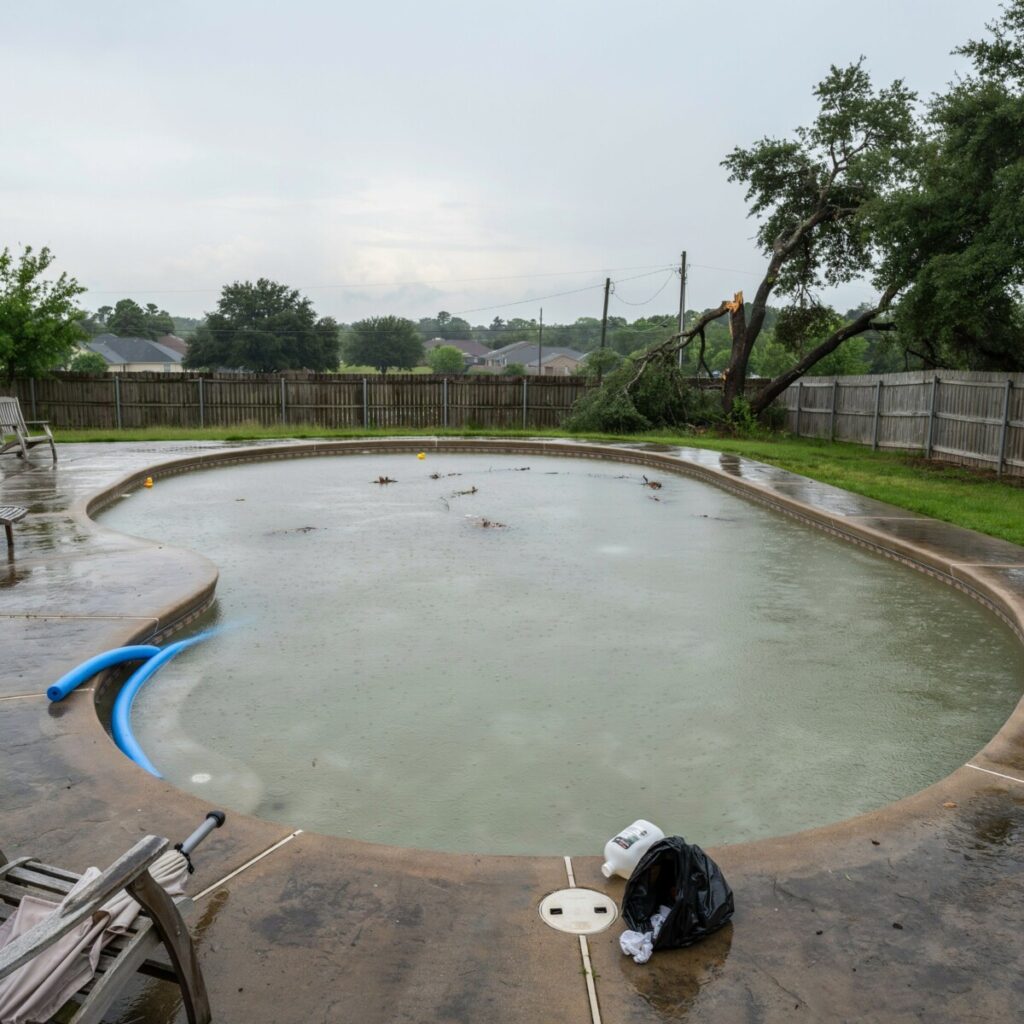
Nothing ruins weekend plans faster than stepping outside to a cloudy, murky pool. The good news: most cloudy pool problems can be diagnosed and corrected overnight with the right tests, chemicals, and filter work. Whether the culprit is a summer thunderstorm rolling through Florida, a spring pollen dump in the Carolinas, or a Saturday barbecue that loaded the water with sunscreen and sweat, the fix follows the same principles—balance the chemistry, aggregate the particles, and let your filtration system do the heavy lifting.
This guide walks you through a safe, step-by-step plan to fix a cloudy swimming pool overnight so you can sleep tonight and swim tomorrow—without draining a single gallon. You’ll learn how to identify the cause, choose between a clarifier and a flocculant, shock the water correctly, and wake up to crystal-clear results.
Quick Safety Checklist Before You Start
Before mixing any chemicals, run through these non-negotiables:
- No swimming during treatment or until free chlorine drops below 5 ppm and the water is visually clear.
- Wear gloves, eye protection, and closed-toe shoes when handling shock, muriatic acid, or flocculant.
- Never mix chemicals together—add each one to the pool separately, and always add chemicals to water, never water to chemicals.
- Store containers in a cool, dry, ventilated area away from sunlight and combustibles.
- Keep kids and pets off the pool deck until the treatment cycle is complete.
- If you smell strong chlorine gas, see foaming, or get confused by test results, stop and call a licensed pool professional.
Diagnose the Cause of Cloudy Pool Water Fast
You can’t clear cloudy pool water overnight if you don’t know why it turned cloudy in the first place. Grab your pool test kit and run a full panel—free chlorine, combined chlorine, pH, total alkalinity, calcium hardness, and cyanuric acid—then compare what you see and what you measure against this quick diagnostic:
| Symptom | Most Likely Cause |
|---|---|
| Dull, milky water with low chlorine reading | Low sanitizer, heavy bather load |
| Cloudy after a rainstorm | Diluted chemistry, debris, phosphates |
| Greenish tint + cloudiness | Early-stage algae bloom |
| Cloudy right after shocking | Pool water cloudy after shock is normal—calcium hypochlorite can temporarily raise turbidity; it usually clears in 12–24 hours |
| Consistently hazy despite good chlorine | High pH, high alkalinity, or fine particles too small for the filter |
| Sudden cloudiness in spring | Pollen, dust, organic load |
pH for pool clarity matters more than most homeowners realize. When pH climbs above 7.8, chlorine becomes sluggish and calcium can precipitate out of solution, creating a fine chalky haze. When total alkalinity exceeds 140 ppm, the water resists pH adjustment and stays stubbornly turbid.
A 10-second visual test also helps: scoop a white bucket of pool water and hold it in full sun. If you can clearly see the bottom of the bucket, the cloudiness is mild and usually chemistry-related. If the water looks like weak lemonade, you’re likely dealing with suspended particles that need a clarifier or flocculant. If it looks like pea soup, assume algae and skip to the algae section below.
Tools and Chemicals You’ll Need
Click to expand the full overnight-clearing supply list
Testing & measurement
- Liquid or tablet pool test kit (test strips work in a pinch but are less accurate)
- Clean sample cup and a log sheet or phone notes app
Chemicals (generic types—follow the label on whatever brand you buy)
- Chlorine shock (calcium hypochlorite or lithium hypochlorite) or non-chlorine shock (potassium monopersulfate) for oxidizing without raising chlorine
- Pool clarifier (polymer-based, for filtration-assisted clearing)
- Pool flocculant (aluminum-based or chitosan-based, for vacuum-to-waste clearing)
- pH decreaser (sodium bisulfate) or muriatic acid (diluted, handle carefully)
- pH increaser (sodium carbonate / soda ash)
- Alkalinity increaser (sodium bicarbonate)
- Phosphate remover (lanthanum-based) if phosphates test above 500 ppb
- Algaecide (polyquat or copper-based) only if algae is confirmed
Equipment
- Telescopic pole, skimmer net, and stiff pool brush
- Manual or automatic pool vacuum capable of “waste” setting
- Filter cleaner (cartridge soak or sand/DE degreaser)
- Replacement cartridge or DE powder if media is worn
Safety & storage
- Chemical-resistant gloves, goggles, long sleeves
- Labeled, sealed, ventilated storage away from heat and organics
Overnight Step-by-Step Plan to Clear Cloudy Water
This is the core of the overnight pool cleaning routine. Start in the late afternoon or early evening so the pump can run 8–12 hours uninterrupted.
Phase 1 — Pre-treatment (30–45 minutes)
- Skim the surface and empty both skimmer and pump baskets. Visible debris steals chlorine and plugs the filter before the real work begins.
- Brush the walls, floor, and steps aggressively. Scrubbing breaks the boundary layer where algae spores and biofilm hide and exposes them to your shock.
- Run the pump on high speed and confirm strong return flow. Weak flow means a clogged filter or failing impeller—fix that first or nothing else will work.
- Backwash a sand or DE filter until the sight glass runs clear, then return to “filter.” For cartridge filters, remove and hose off the pleats, or soak in filter cleaner if they’re more than a season old. Pool filter cleaning at this stage is the single biggest predictor of success.
- Test and record all chemistry readings. Write them down—you’ll need the baseline to calculate dosing.
Phase 2 — Correcting the Chemistry (20–30 minutes)
The target ranges for a successful overnight clear:
- Free chlorine: 1–3 ppm normal; 10+ ppm during shock
- pH: 7.2–7.6 (critical—adjust pH before shocking, because high pH neutralizes chlorine)
- Total alkalinity: 80–120 ppm
- Cyanuric acid (CYA): 30–50 ppm for outdoor pools
How to shock a pool correctly: raise free chlorine to roughly 10 ppm above your “breakpoint” level. A general rule of thumb is that 1 pound of calcium hypochlorite shock per 10,000 gallons adds approximately $10 \text{ ppm}$ of free chlorine. So a 20,000-gallon pool starting at 2 ppm that needs to reach 12 ppm needs about a 10 ppm boost, which equals roughly 2 pounds of shock. Always pre-dissolve granular shock in a bucket of pool water and broadcast it evenly around the perimeter with the pump running.
Sequence matters:
- Adjust total alkalinity first (bicarbonate) if below 80 ppm.
- Adjust pH second (acid or soda ash).
- Wait 30 minutes, retest, then add shock.
Adding chemicals out of order can waste product and extend cloudiness—this is the most common reason a cloudy pool solution fails.
Phase 3 — Clarifier vs. Flocculant: Which One to Use?
Once chemistry is balanced and the shock is circulating, suspended micro-particles are what’s keeping the water hazy. You have two tools:
Use a pool clarifier when…
- The cloudiness is mild to moderate.
- Your filter is in good shape and can run overnight.
- You want a “set it and forget it” approach.
Clarifiers are cationic polymers that clump tiny particles into larger ones your cartridge filter, sand filter, or DE filter can actually catch. Add the label-directed dose near the skimmer, keep the pump on high for 8–12 hours, and the filter does the rest. You may need to backwash or rinse the cartridge once mid-cycle if pressure climbs.
Use a pool flocculant when…
- The water is heavily cloudy, almost opaque.
- You have a multiport valve with a “waste” setting or a vacuum-to-waste setup.
- You’re willing to vacuum the next morning.
Flocculants are heavier and sink particles to the floor in a visible blanket. The trade-off: you cannot run the filter overnight on flocculant (it’ll gum up the media). Add the dose, circulate for 1–2 hours, then turn the pump off for 8–10 hours while particles settle. This is the classic how to vacuum cloudy pool scenario the next morning.
Mini case study: After a July thunderstorm dumped two inches of rain and a lawn’s worth of runoff into a 15,000-gallon pool in Atlanta, the homeowner tested, found phosphates off the chart and chlorine near zero. They dosed phosphate remover, applied a double shock at 8 PM, ran clarifier with the pump overnight, and woke up to a slightly hazy but swimmable pool by 9 AM—one more 4-hour filter run and it was glass-clear.
Phase 4 — Filter Guidance for Overnight Runs
- Sand filters: backwash whenever pressure rises 8–10 psi above clean pressure. After a clarifier treatment, expect to backwash once or twice.
- DE filters: backwash and recharge with fresh DE powder (about 1–2 lbs per 10 sq ft of filter area).
- Cartridge filters: swap to a clean, dry spare if you have one; a fouled cartridge will slow flow and stall progress.
Keep the pump running continuously from dosing until mid-morning. Short cycling defeats the purpose of overnight pool cleaning.
Phase 5 — Monitoring and Troubleshooting During the Night
Set an alarm for around midnight if you’re using clarifier. Check:
- Is pressure climbing fast? Backwash or rinse the cartridge.
- Is the water clearing at the shallow end first? Good sign—filtration is working.
- Is the water more pool water cloudy after shock than before? That’s expected with cal-hypo in hard water; it will settle.
If you used flocculant, don’t touch anything overnight. Disturbance re-suspends the floc and resets the clock.
When Cloudy Water Is Algae-Related
If the tint is green, yellow-green, or has black patches along grout lines, you’re dealing with an algae bloom and the playbook changes. A standard pool algae treatment is more aggressive:
- Brush every surface, including behind ladders and light niches.
- Lower pH to 7.2 so chlorine is maximally active.
- Perform a triple-shock (roughly 3 lbs cal-hypo per 10,000 gallons) at dusk.
- Run the pump 24 hours straight, backwashing every 6–8 hours.
- Add a polyquat algaecide the next morning after chlorine drops below 5 ppm (chlorine and algaecide can neutralize each other at high doses).
- Continue brushing daily and retesting until the water holds chlorine overnight—this is the true end-point of an algae kill.
Green and yellow algae typically clear in 24–48 hours. Black algae may require a week of daily brushing with a stainless-steel brush (plaster pools only) and repeat shocking.
Morning After: Testing and Aftercare
Click to expand your next-morning checklist
If you used a clarifier overnight:
- Check filter pressure; backwash or rinse if it’s up 8+ psi.
- Test free chlorine, pH, and alkalinity.
- If chlorine is under 5 ppm and water is clear, the pool is safe to swim.
- If still slightly hazy, keep the pump running another 4–6 hours.
If you used a flocculant overnight:
- Do NOT turn the pump on yet.
- Set the multiport valve to “waste.”
- Vacuum slowly across the floor, disturbing the floc blanket as little as possible. Slow passes are essential—rushing re-clouds the water.
- Once the floor is clean, return the valve to “filter,” top off the pool (you lost water to waste), and retest chemistry.
- Run the filter for 4–6 hours before swimming.
How long to wait to swim after shocking pool water?
The safe rule: free chlorine must be at or below 5 ppm and combined chlorine below 0.5 ppm. With a standard evening shock, that’s usually 8–12 hours. When in doubt, test—never guess.
One last question homeowners always ask: can you swim in cloudy pool water? The answer is almost always no. Cloudiness hides the drain, masks early algae, means sanitizer is struggling, and often signals poor filtration. Clear the water first.
Preventing Cloudy Water in the Future
Click to expand the weekly prevention routine
- Run the pump at least 8 hours daily in summer (one turnover minimum).
- Shock weekly during heavy-use months, bi-weekly in cooler seasons.
- Test chemistry twice a week and log results—trends catch problems before they turn the pool opaque.
- Keep skimmer and pump baskets clean; a full basket starves the filter.
- **Use a *phosphate remover pool* treatment quarterly if you’re in an agricultural area or have lots of runoff.
- Enzyme or clarifier maintenance dose once a week prevents organic buildup.
- Cover the pool during storms, heavy pollen events, and off-season to cut debris load dramatically.
- Replace filter media on schedule: cartridges every 1–2 years, sand every 5–7 years, DE grids every 5–8 years.
Following these pool maintenance tips turns “how to fix cloudy pool water overnight” from a frequent emergency into a once-a-season rarity.
When to Call a Pool Professional
DIY works for the vast majority of cloudy-pool cases, but bring in a licensed technician if:
- Cloudiness returns within days of clearing (suggests hidden algae or a failing filter).
- CYA exceeds 100 ppm—the only fix is a partial drain and refill.
- The pump loses prime repeatedly or pressure readings make no sense.
- Test-kit colors look wrong or you get conflicting readings.
- You suspect a leak (cloudy water plus a dropping water level is a red flag).
A pro has commercial-grade oxidizers, digital photometers, and pressure-testing gear that make diagnosis fast and certain.
Quick Overnight Checklist
Keep this on your phone for the next cloudy-pool emergency:
- [ ] Skim, brush, empty baskets
- [ ] Clean or backwash filter
- [ ] Test & log: FC, pH, TA, CYA
- [ ] Adjust alkalinity → then pH → then shock
- [ ] Dose clarifier or flocculant (not both)
- [ ] Run pump 8–12 hours (or turn OFF if using floc)
- [ ] Retest next morning; vacuum floc to waste if used
- [ ] Swim only when FC ≤ 5 ppm and water is clear